The funding will support projects that reduce the risk of vehicle-wildlife collisions and improve habitat connectivity.


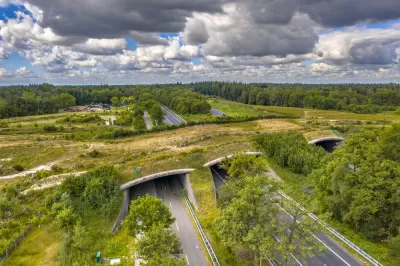
A ‘first-of-its-kind’ federal program aims to improve road safety and habitat connectivity for wildlife, according to a press release from the U.S. Department of Transportation (USDOT).
“The program, which was created through the Bipartisan Infrastructure Law, previewed at the White House Conservation in Action Summit last month, and will be administered by the Federal Highway Administration, makes grant funding available to states and communities to construct wildlife crossings over or below busy roads, add warning signs for drivers, acquire mapping and tracking tools, and more.”
Around 200 people and countless animals are killed in vehicle crashes every year in the United States. The program is part of the new Safe System Approach called for in the National Roadway Safety Strategy (NRSS) issued by USDOT in 2022. “The projects funded by the Wildlife Crossings pilot program will improve the overall safety of the traveling public and reduce the economic drain caused by wildlife crashes (such as loss of income, medical costs, property damage, and decline in productivity and quality of life), while simultaneously supporting species survival.”

New USDOT safety strategy highlights enforcement, embraces autonomous cars
The new National Roadway Safety Strategy emphasizes safety technology and enforcement and promises to further crack down on immigrant truck drivers with illicitly obtained licenses.

USDOT Blocks Federal Funding for Traffic Cameras
Applicants to the Safe Streets and Roads for All grant program will not be allowed to use funds for automated traffic enforcement.

USDOT Awards New Round of Safe Streets Grants
Over 200 cities and towns will receive $82 million for Complete Streets and other road safety planning and demonstration programs.

Planetizen Federal Action Tracker
A weekly monitor of how Trump’s orders and actions are impacting planners and planning in America.

The state-sanctioned urbicide of Austin
People don’t kill cities. Freeways do.

US to reduce Colorado River water deliveries to Mexico
A new Colorado Treaty amendment reduces Mexico’s Colorado River water allocation by 250,000 acre feet.

5 New England states march closer to 800 megawatt wind energy project
Securing federal approval for the project may be complicated under the Trump administration, which has historically been hostile towards domestic wind power.

Baltimore to break ground on $50 million Transit Priority Project
The project will bring faster bus trips, safer streets and better bike connections to Baltimore.

Airbnb launches $250 million 'last-dollar financing' housing accelerator, makes first investment in Austin
The company will put $6.4 million towards affordable housing development in Texas’ capital.

FREE Course: Walkable City 1: Why Walkability?
After describing his path towards focusing on walkability as the essence of good planning, Jeff Speck marches through his five principal reasons for making more walkable places.
Reinventing Malls: Planning Alchemy—Turning Gray Fields Into Gold
The course focuses on the opportunities and imperatives that shape reinvention of mall sites.

Eagle County Government
Harvard University Graduate School of Design
Nashville Planning Department
The Architects Foundation
University of Cincinnati Online
The Pocatello Development Authority
The Urban Renewal Agency of the City of Pocatello
Journal of the American Planning Association