The Orange County beachfront community has had enough of the California State Legislature’s preemption of local zoning laws.



The newest front in the battle over local control in California can be found in Huntington Beach, Orange County, where city officials have stopped permitting accessory dwelling units and are considering a legal challenge against state-mandated residential density.
Huntington Beach is a relatively conservative city in a state famous, whether fairly or not, for liberal politics. Huntington Beach attracted attention during the height of the pandemic in late fall 2020, with large protests of the state’s stay-at-home orders and curfew. The protests and adjacent episodes earned the city the nickname ‘Angrytown, USA’ from the Los Angeles Times.
Fast forward to the city’s most recent election, in November 2022, when voters elected a strongly conservative city council majority. According to an article by Jill Replogle for LAist, “The new council promptly vowed to fight state laws and mandates that overrule city zoning rules and would force it to allow more dense housing developments.”
According to Replogle, the Huntington Beach City Council will vote soon whether or not to mount a legal challenge to SB 9 and SB 10, two statewide housing laws approved in 2021, intended to spur housing production by loosening local zoning controls. Four cities located to the north in Los Angeles County—Redondo Beach, Torrance, Carson, and Whittier—announced a similar lawsuit to challenge SB 9 in April 2022.
“Huntington Beach is already considering adopting a rule that would exempt it from the state ‘builder's remedy,’ which allows developers to bypass local zoning if a city lacks an approved housing plan,” reports Replogle.
The City Council voted at the same meeting on February 21 to cease permitting of accessory dwelling units—residential developments allowed by several rounds of state law, including laws approved by the State Legislature in 2019 and 2016.
Read the full story: Huntington Beach Wants To Take On California Over Duplexes, ADUs

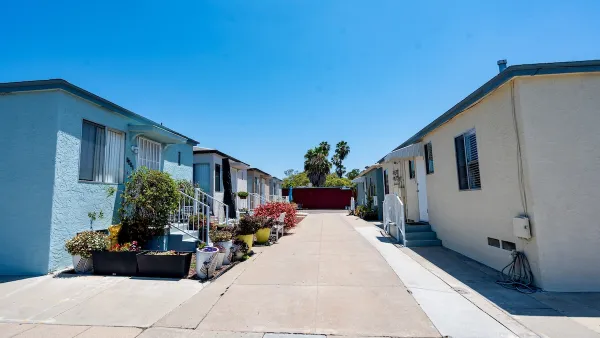
San Diego Begins to See Results of State Housing Law
Homeowners in Southern California are starting to take advantage of a state law that allows lot splitting and higher density in residential areas in an effort to increase housing supply and affordability.

California Gives 15 Cities ‘Final Warning’ to Submit Mandatory Housing Plans
Communities are required to produce housing elements that accommodate sufficient housing for all income levels.
Delaware Governor Could Force Cities to Upzone
Gov. Meyer says the state will work with cities to encourage land use reforms that make room for more affordable housing types, but could take stricter measures if jurisdictions don’t comply.

Planetizen Federal Action Tracker
A weekly monitor of how Trump’s orders and actions are impacting planners and planning in America.

California plans to bury El Niño’s downpour
If the state plays its cards right, it may be able to store a billion acre-feet of El Niño’s water in aquifers.

Desperate measures: Advocates weigh draining Lake Powell to fill Colorado River
Draining the reservoir could reduce evaporation losses by a couple hundred thousand acre-feet.

California city breaks ground on transit connector
The project includes three mobility hubs and a pedestrian bridge.

After public outcry, Massachusetts city releases housing development tracker
Cambridge’s tracker currently shows 250 housing projects in various stages of development.

40 years after approval, Chicago breaks ground on new park
The park honors Jean Baptiste Point du Sable, the city’s first permanent non-native settler.

FREE Course: Walkable City 1: Why Walkability?
After describing his path towards focusing on walkability as the essence of good planning, Jeff Speck marches through his five principal reasons for making more walkable places.
Reinventing Malls: Planning Alchemy—Turning Gray Fields Into Gold
The course focuses on the opportunities and imperatives that shape reinvention of mall sites.

City of Rosemead
Rutgers University, Edward J. Bloustein School of Planning and Public Policy
One Hundred Miles
Hunter College, City University of New York (CUNY)
The Architects Foundation
University of Cincinnati Online
City of Cambridge
Montrose County
The Pocatello Development Authority