In California and elsewhere, power outages can threaten the lives of people dependent on medical devices, while evacuation plans often don’t account for the needs of disabled people.



Power outages caused by extreme weather events doubtlessly cause inconvenience for everyone, but for some people—namely, those living with disabilities—access to power can be a life or death issue. Yet, as Alice Wong points out in an article for High Country News, “Time and time again, disabled and older people are left behind or not prioritized in emergency planning.”
Wong details a day in her life as a disabled American concerned about an imminent power outage in her home, where she depends on a variety of electric devices for her survival and well-being. Many others face similar challenges.
Meanwhile, much of the advice given to residents to prepare for emergencies is difficult or impossible for many disabled people. For example, “People cannot stock up on medications if they are uninsured or underinsured. And recommended mitigation efforts — such as unplugging all appliances during an outage and purchasing equipment like generators — are out of reach financially and physically for many of us.”
According to a 2021 statement from the National Council on Disability, “A vital part of effective planning is an understanding of the diverse populations that make up the community, including their strengths and their weaknesses.”
Wong suggests several ways utility companies can help, such as increasing funding to disability organizers, hiring disabled people to develop policies, and boosting rebate programs for batteries, generators, and other crucial equipment.
Read the full story: California’s power outages are a life-and-death issue

The New Regionalism of the Coronavirus Pandemic
In the absence of federal leadership in dealing with the coronavirus pandemic, East Coast states and West Coast counties have collaborated to implement uniform containment strategies to arrest the spread of COVID-19, and it's catching on.
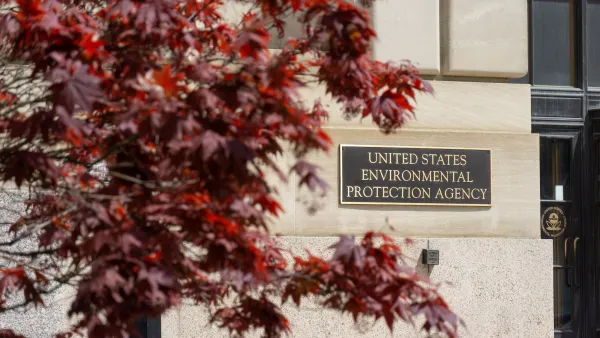
Trump's proposed budget slashes EPA funding by 52%
The budget also reduces funding for FEMA, climate resilience projects, and water infrastructure programs.
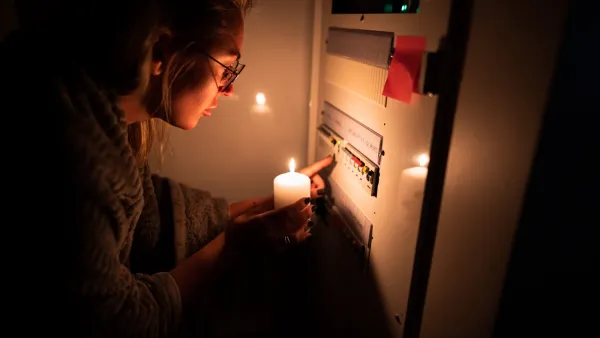
US May Have 100 Times More Blackouts by 2030
Rising demand driven by AI data centers and uncertain energy sources could lead to a surge in power outages by the end of the decade.

Planetizen Federal Action Tracker
A weekly monitor of how Trump’s orders and actions are impacting planners and planning in America.

California plans to bury El Niño’s downpour
If the state plays its cards right, it may be able to store a billion acre-feet of El Niño’s water in aquifers.

Desperate measures: Advocates weigh draining Lake Powell to fill Colorado River
Draining the reservoir could reduce evaporation losses by a couple hundred thousand acre-feet.

Mamdani’s pied-à-terre tax survives legal challenge
A panel of judges found that the plaintiffs failed to demonstrate injury as a result of New York City's implementation of the tax.

Eastern Nebraska is running out of electricity
Data centers and electrification are straining eastern Nebraska’s grid, throttling economic development.

Seattle passes record-breaking transit services expansion
Proposition 1 will double the city’s transit tax to add 95,000 more bus trips and preserve 180,000 bus trips annually.

FREE Course: Walkable City 1: Why Walkability?
After describing his path towards focusing on walkability as the essence of good planning, Jeff Speck marches through his five principal reasons for making more walkable places.
Reinventing Malls: Planning Alchemy—Turning Gray Fields Into Gold
The course focuses on the opportunities and imperatives that shape reinvention of mall sites.

City of Rosemead
Rutgers University, Edward J. Bloustein School of Planning and Public Policy
One Hundred Miles
University of Michigan School for Environment and Sustainability (SEAS)
Hunter College, City University of New York (CUNY)
The Architects Foundation
City of Cambridge
Montrose County
The Pocatello Development Authority