Residents in far-flung parts of the region can connect to rail and bus lines and access local destinations through an on-demand service called the Denver Connector.


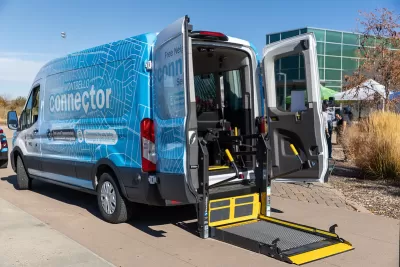
An on-demand transit service in Denver aimed at helping residents supplement regional bus service is proving successful, reports Jon Murray in the Denver Post.
As Murray explains, “City officials’ initial hope was simple: to bridge transit gaps within an outlying part of the city where homes on winding streets are a good trek from grocery stores, community centers, rail stations and other vital services.” For the city, “the Denver Connector was fast and easy to put in place.”
“In its first year, the Montbello Connector took off, with monthly ridership reaching 5,201 passengers in November, according to city data. The city and its partners recently added Gateway to the original service area and, in mid-November, launched a second Denver Connector service — this time focused on Globeville and Elyria-Swansea, similarly disconnected neighborhoods located north of downtown.” Lone Tree, another city in the Denver metro area, is using a similar service called Link On Demand to provide on-demand service that connects residents to light rail stations and destinations around town.
The $3.2 million Denver pilot program has been extended until the end of 2024.
Read the full story: Denver Connector fills transit gaps in more neighborhoods with “godsend” of on-demand service
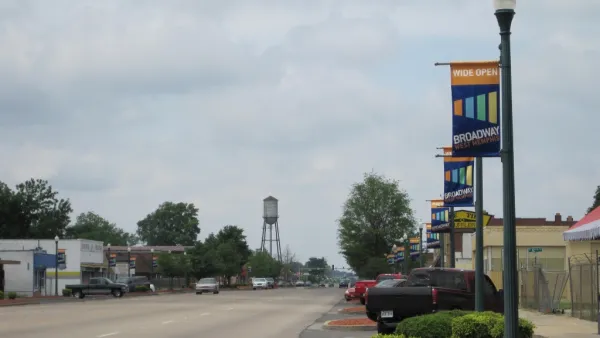
West Memphis to launch new transit system
The city across the Mississippi River from Memphis, Tennessee will soon begin service on its own, on-demand transit system.

El Paso launches improved bus network, new microtransit service
Sun Metro is eliminating some bus lines in favor of more frequent service, estimating that only 1% of riders will have to walk farther to reach a station.

South Florida Microtransit Nears 1.5 Million Rides
Fort Lauderdale’s LauderGO! shuttle service reported 700,000 rides.

Planetizen Federal Action Tracker
A weekly monitor of how Trump’s orders and actions are impacting planners and planning in America.

Eastern Nebraska is running out of electricity
Data centers and electrification are straining eastern Nebraska’s grid, throttling economic development.

Study reveals best places in the U.S. for cycling, walking
New research from Streetlight Data examines bicycle and pedestrian miles per capita in the 100 largest U.S. cities by population.

DSA members accuse Mamdani of 'abandoning values' over housing redevelopment
New York City's mayor plans to replace about 2,000 units of public housing with private, mixed-income housing.

All sides of BRT debate unhappy with CDOT’s most recent move
The Colorado Department of Transportation is no longer considering center-running bus lanes for Colorado Boulevard.

Massachusetts bogs generate both power, and cranberries
Putting solar panels above farmland is one way Massachusetts is advancing toward its goal of net-zero carbon emissions by 2050.

FREE Course: Walkable City 1: Why Walkability?
After describing his path towards focusing on walkability as the essence of good planning, Jeff Speck marches through his five principal reasons for making more walkable places.
Reinventing Malls: Planning Alchemy—Turning Gray Fields Into Gold
The course focuses on the opportunities and imperatives that shape reinvention of mall sites.

City of Rosemead
Rutgers University, Edward J. Bloustein School of Planning and Public Policy
One Hundred Miles
University of Michigan School for Environment and Sustainability (SEAS)
Hunter College, City University of New York (CUNY)
The Architects Foundation
City of Cambridge
The Pocatello Development Authority
The Urban Renewal Agency of the City of Pocatello