Roundabouts, which can dramatically improve traffic safety, have been slowly proliferating across U.S. cities over the last two decades.


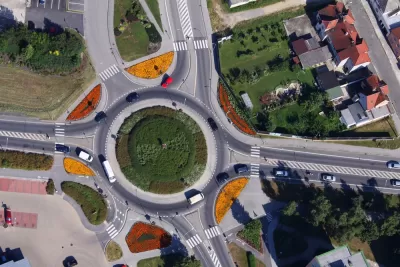
Although a lack of federal data makes it difficult to evaluate the scale of their growth, roundabouts and traffic circles are slowly but surely making their way into American cities, writes Andrew Van Dam in the Washington Post.
According to Lee Rodegerdts, who literally wrote the book on roundabouts—Roundabouts: An Informational Guide—there are now roughly 9,000 roundabouts around the country, plus over 160 rotaries and more than 700 traffic-calming circles.
Florida boasts the most roundabouts, but it also has the third-largest population in the nation. Nebraska has the most roundabouts per person, but they’re spread across one of the sparsest (and often most scenic) road networks in the country. Per mile of road, Maryland actually emerges as the roundabout champion.
As far as cities go, the wealthy enclave of Carmel, just outside Indianapolis, has more roundabouts than any other U.S. locality thanks to its long-term mayor, who has championed roundabouts for decades. Carmel has built more than 140 roundabouts under his tenure.
“Why add a roundabout, you might ask. Because roundabouts offer impressive safety gains. In general, a roundabout will drive down fatal crashes by 90 percent and cut all car-crash injuries by at least 75 percent, even while accommodating a higher volume of cars.” The benefit is even greater at rural two-way stops, cutting traffic injuries by as much as 90 percent.
FULL STORY: The rise of the roundabout and which state has the most

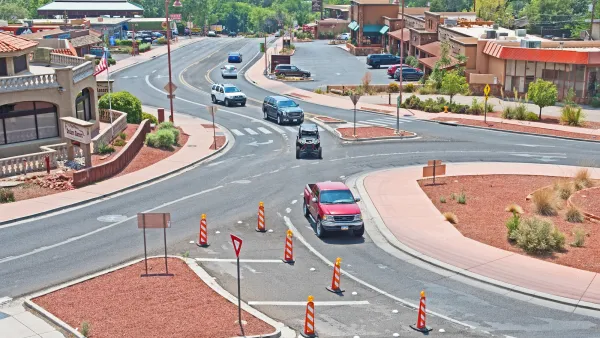
Study: Roundabouts are Primarily in Wealthier Neighborhoods
A North Carolina study sheds light on inequities in road safety interventions.
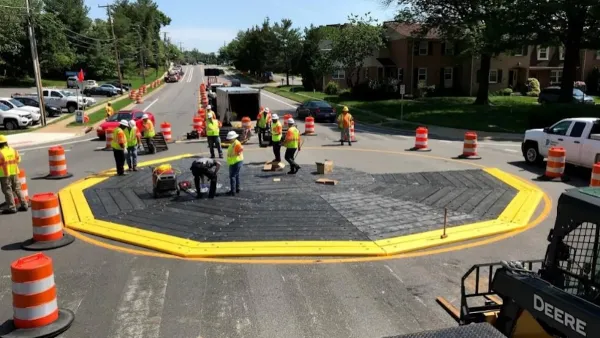
‘Modular Roundabouts’ Offer Quick-Build Traffic Safety Solution
The prefabricated roundabouts can be installed more quickly and at a much lower cost than traditional concrete traffic circles.
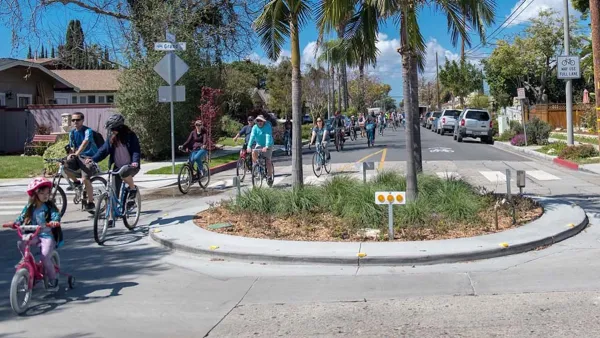
Long Beach Has Installed Nearly 100 Traffic Circles
They range from large traffic circles that reduce congestion to small neighborhood roundabouts designed to slow local traffic.

Planetizen Federal Action Tracker
A weekly monitor of how Trump’s orders and actions are impacting planners and planning in America.

The state-sanctioned urbicide of Austin
People don’t kill cities. Freeways do.

US to reduce Colorado River water deliveries to Mexico
A new Colorado Treaty amendment reduces Mexico’s Colorado River water allocation by 250,000 acre feet.

5 New England states march closer to 800 megawatt wind energy project
Securing federal approval for the project may be complicated under the Trump administration, which has historically been hostile towards domestic wind power.

Baltimore to break ground on $50 million Transit Priority Project
The project will bring faster bus trips, safer streets and better bike connections to Baltimore.

Airbnb launches $250 million 'last-dollar financing' housing accelerator, makes first investment in Austin
The company will put $6.4 million towards affordable housing development in Texas’ capital.

FREE Course: Walkable City 1: Why Walkability?
After describing his path towards focusing on walkability as the essence of good planning, Jeff Speck marches through his five principal reasons for making more walkable places.
Reinventing Malls: Planning Alchemy—Turning Gray Fields Into Gold
The course focuses on the opportunities and imperatives that shape reinvention of mall sites.

Eagle County Government
Harvard University Graduate School of Design
Nashville Planning Department
The Architects Foundation
University of Cincinnati Online
The Pocatello Development Authority
The Urban Renewal Agency of the City of Pocatello
Journal of the American Planning Association