Former President Barack Obama was at the AIA’s national conference in Chicago earlier this month. His presentation included some strong words about the effects of sprawl.



“Former US president Barack Obama has called on architects and policymakers to tackle urban sprawl and to "create livable density" in American cities,” reports Ben Dreith for Dezeen.
"Sprawl in America is not good for our climate. And so we have to think about creating livable density that allows us to take mass transit and take bicycles,” Obama is quoted as saying in the article.
Obama also cited Chicago as an example of a city where architecture had been used to reinforce inequality, such as with public housing projects like Cabrini Green.
“The former president believes that some of the problems found in Chicago and other major cities in the US are the result of government policy and zoning decisions,” reports Dreith. “[I]t's not just a lack of funding for affordable housing,” said the former president.
Obama also called out ostensibly liberal cities for opposing affordable housing.
"Frankly, some very well-intentioned laws and regulations at the local level, often generated from the left and from my own party, sometimes are inhibiting the creation of affordable housing and powering NIMBY attitudes and make it very difficult to integrate communities and allow people to live close to where they work."
Obama’s track record while in office on issues of urbanism and equity shows some incremental progress, stopping well short of comprehensive innovation. While the Obama administration succeeded in implementing the Affirmatively Furthering Fair Housing (AFFH) rule to advance the causes of the Fair Housing Act, the Trump administration worked to undermine those rules and critics questioned how effective the AFFH will be in achieving its intended goals. The Obama administration also supported pro-development reforms well before it was a broad trend at the local level.
FULL STORY: Sprawl in America "is not good for our climate" says Barack Obama

‘Divided by Design’ Underscores Inequities in Transportation Policy
The report calls for a wholesale overhaul of U.S. transportation policy to redress the damages caused by decades of auto-centric development.

Lack of Multi-Family Zones Contributes to Nashville’s High Housing Costs, Study Says
Nashville and surrounding communities allow for a relatively small amount of multi-family housing, according to a new zoning atlas of Middle Tennessee. A regionally focused nonprofit is using the atlas to push for zoning reforms.
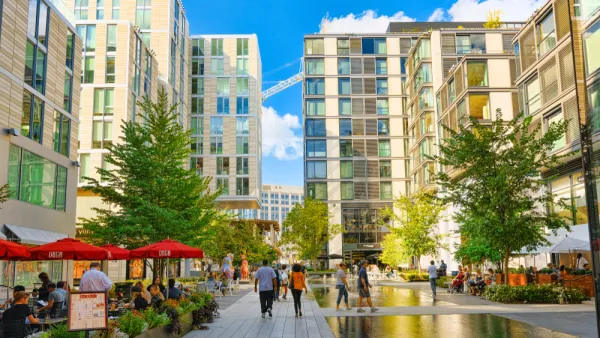
D.C. Regional Framework Emphasizes Equity, Connectivity
The Region United Framework for 2030 outlines a plan for sustainable, equitable development, calling for a 'holistic' approach to regional planning.

Planetizen Federal Action Tracker
A weekly monitor of how Trump’s orders and actions are impacting planners and planning in America.

The state-sanctioned urbicide of Austin
People don’t kill cities. Freeways do.

US to reduce Colorado River water deliveries to Mexico
A new Colorado Treaty amendment reduces Mexico’s Colorado River water allocation by 250,000 acre feet.

Mamdani overhauls NYC's Vision Zero plan with 100 new policy goals
The overhaul aims to reduce traffic deaths and make streets safer for pedestrians, cyclists and drivers through lower speed limits, new safety infrastructure and more.

Amtrak not solely to blame for New Jersey commuter rail's unreliability, report finds
A new study from the Garden State Initiative found that NJ Transit’s budget grew 20% across a 4 year period, but reliability declined significantly over the same period.

EPA erases limits on planet-warming pollution from power plants
Under Monday’s plan, power plants would still have some limits on how much mercury, arsenic and other contaminants they can emit.

FREE Course: Walkable City 1: Why Walkability?
After describing his path towards focusing on walkability as the essence of good planning, Jeff Speck marches through his five principal reasons for making more walkable places.
Reinventing Malls: Planning Alchemy—Turning Gray Fields Into Gold
The course focuses on the opportunities and imperatives that shape reinvention of mall sites.

Eagle County Government
Harvard University Graduate School of Design
Nashville Planning Department
The Architects Foundation
University of Cincinnati Online
The Pocatello Development Authority
The Urban Renewal Agency of the City of Pocatello
Journal of the American Planning Association