Environmental causes run into conflict with zoning reforms intended for environmental benefit once again, as the California Coastal Commission requires San Diego to reinstate parking requirements for ADUs.


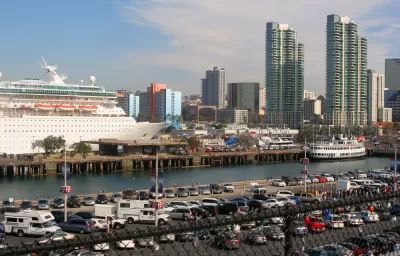
The California Coastal Commission (CCC), citing the public access requirements of the California Coastal Act, nixed zoning reforms approved by the city of San Diego making it possible to build accessory dwelling units without parking requirements.
A paywalled article by David Garrick for the San Diego Tribune reports the news, noting that the actions of the California Coastal Commission will apply only in the coastal areas o the city governed by the extra regulations of the California Coastal Act.
For non-paywalled news on the same story, an article by Frank Gormlie for OB Rag reports that the San Diego City Council has responded to the demands of the California Coastal Act by voting to rescind the parking reforms for accessory dwelling units in the coastal area.
Researchers have documented for years the lengths private property owners will go to restrict public access to the California coastline—a right guaranteed by the California Coastal Act approved in 1976—in addition to anecdotes reported in the news. The mandate to ensure access to coastal areas has for years focused on the inclusion of parking in coastal developments. The pressures between public access and private land ownership is mentioned in the CCC decision to block San Diego’s parking reforms.
It represents a potential substantial intensification of residential development in the coastal zone without a commensurate increase in off-street parking. An increase in parking demand could result in residents of the accessory uses, the primary residence, or both, occupying public parking that would otherwise be used by coastal visitors, increasing the burden of accessing the coast and deterring coastal recreation. -California Coastal Commission
A reasonable argument could be made, however, that exclusionary zoning regulations, such as onerous parking requirements, do more to restrict access to the California coast than any lack of parking. There is also, of course, the proven fact that parking induces Vehicle Miles Traveled (VMT) and increases greenhouse gas (GHG) emissions. Because transportation is the leading source of GHG emissions in the United States, parking requirements like those enforced in San Diego by the California Coastal Commission also present an existential risk to the coast of California, through sea-level rise, species extinction, and other negative externalities created by climate change.


Parking Requirements Removed Near Cleveland Transit Stops
Transit oriented parking reform has arrived in Cleveland.

Four ‘Low-Hanging Fruit’ Zoning Reforms
An excerpt from the latest book on zoning argues for four approaches to reform that can immediately improve land use regulation in the United States.

San Diego Removes Some Commercial Parking Requirements
After approving parking reforms for swaths of residential areas in the city in 2019, the city of San Diego is expanding the effort to select commercial areas in the city.

Planetizen Federal Action Tracker
A weekly monitor of how Trump’s orders and actions are impacting planners and planning in America.

The state-sanctioned urbicide of Austin
People don’t kill cities. Freeways do.

US to reduce Colorado River water deliveries to Mexico
A new Colorado Treaty amendment reduces Mexico’s Colorado River water allocation by 250,000 acre feet.

Mamdani overhauls NYC's Vision Zero plan with 100 new policy goals
The overhaul aims to reduce traffic deaths and make streets safer for pedestrians, cyclists and drivers through lower speed limits, new safety infrastructure and more.

Amtrak not solely to blame for New Jersey commuter rail's unreliability, report finds
A new study from the Garden State Initiative found that NJ Transit’s budget grew 20% across a 4 year period, but reliability declined significantly over the same period.

EPA erases limits on planet-warming pollution from power plants
Under Monday’s plan, power plants would still have some limits on how much mercury, arsenic and other contaminants they can emit.

FREE Course: Walkable City 1: Why Walkability?
After describing his path towards focusing on walkability as the essence of good planning, Jeff Speck marches through his five principal reasons for making more walkable places.
Reinventing Malls: Planning Alchemy—Turning Gray Fields Into Gold
The course focuses on the opportunities and imperatives that shape reinvention of mall sites.

Eagle County Government
Harvard University Graduate School of Design
Nashville Planning Department
The Architects Foundation
University of Cincinnati Online
The Pocatello Development Authority
The Urban Renewal Agency of the City of Pocatello
Journal of the American Planning Association