A homeowners group has successfully moved to severely limit public access to the beaches of Hollister Ranch, a 14,500-acre parcel to the west of Santa Barbara.


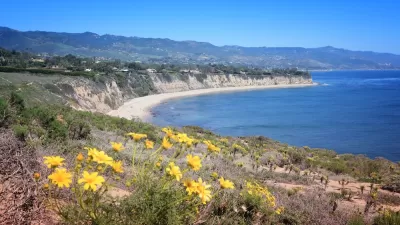
In a blow for California coastal access advocates, the Hollister Ranch Owners Association has secured a settlement blocking most public access to a significant stretch of California coastline. Rosanna Xia writes, "The settlement — signed by the California State Coastal Conservancy and the state Coastal Commission on one side and the Hollister Ranch Owners Assn. on the other — grants the public a roughly three-quarter-mile section of beach, accessible only by ocean 'via surfboard, paddleboard, kayak or soft-bottom boat.'"
"The settlement comes at a time when high-powered interests across California are fighting the state's landmark Coastal Act, which declares that access to the beach is a fundamental right guaranteed to everyone." The Coastal Act has been under siege from real estate interests for many years.
Hollister Ranch landowners, Xia writes, have "infamously kept the public at bay with a guard shack, gates and security patrols." While advocates from organizations like the California Coastal Protection Network believe the public wasn't properly consulted prior to the settlement, "landowners have contended that letting the public in could spoil the ranch's coastline and undo years of effort to protect the environment."
Read the full story: Soon you can visit this pristine California beach — if you're a nearby landowner, on a guided tour or willing to paddle 2 miles
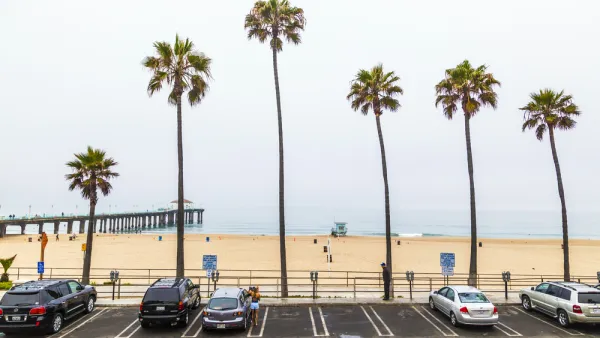
The Inequities of Beach Access
Over 80% of Californians live within an hour’s drive of a beach, but that does not mean that everyone has easy access to beaches.
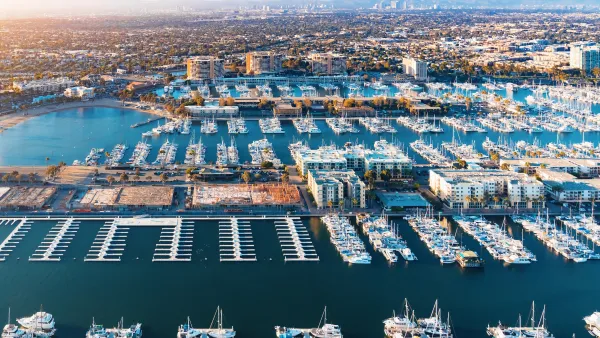
Reimagining Marina del Rey
Los Angeles County is conducting a community needs assessment and planning effort to re-envision and remove barriers to accessing Marina del Rey as a vibrant waterfront destination for all.
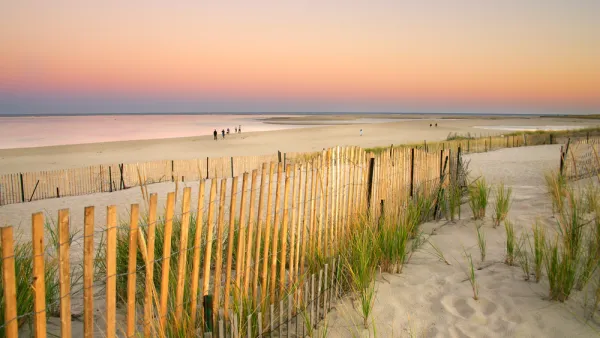
Proposed Law Would Open Beach Access in Massachusetts
It's harder to access the ocean in Massachusetts than any other coastal state in the country, but that could soon change.

Planetizen Federal Action Tracker
A weekly monitor of how Trump’s orders and actions are impacting planners and planning in America.

California plans to bury El Niño’s downpour
If the state plays its cards right, it may be able to store a billion acre-feet of El Niño’s water in aquifers.

Desperate measures: Advocates weigh draining Lake Powell to fill Colorado River
Draining the reservoir could reduce evaporation losses by a couple hundred thousand acre-feet.

Mamdani’s pied-à-terre tax survives legal challenge
A panel of judges found that the plaintiffs failed to demonstrate injury as a result of New York City's implementation of the tax.

Eastern Nebraska is running out of electricity
Data centers and electrification are straining eastern Nebraska’s grid, throttling economic development.

Seattle passes record-breaking transit services expansion
Proposition 1 will double the city’s transit tax to add 95,000 more bus trips and preserve 180,000 bus trips annually.

FREE Course: Walkable City 1: Why Walkability?
After describing his path towards focusing on walkability as the essence of good planning, Jeff Speck marches through his five principal reasons for making more walkable places.
Reinventing Malls: Planning Alchemy—Turning Gray Fields Into Gold
The course focuses on the opportunities and imperatives that shape reinvention of mall sites.

City of Rosemead
Rutgers University, Edward J. Bloustein School of Planning and Public Policy
One Hundred Miles
University of Michigan School for Environment and Sustainability (SEAS)
Hunter College, City University of New York (CUNY)
The Architects Foundation
City of Cambridge
Montrose County
The Pocatello Development Authority