Advocates in Philadelphia are pushing state lawmakers to finally pass a law to make it easier to install protected bike lanes on state routes.


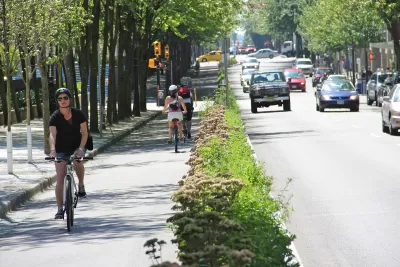
Sophia Schmidt reports from Philadelphia, where a recent study into the benefits of protected bike lanes are giving local planners ammunition in their support for a proposed state law that would make it easier to build robust bike infrastructure on state routes.
“There are currently around 20 miles of protected bike lanes in the city, including parking-separated bike lanes,” according to an expert cited in the article. “But state law makes it difficult for the city to install these bike lanes on state routes that are maintained by PennDOT — which are often where they’re needed most.”
H.B. 140 would make it easier for the city to install protected bike lanes on state routes, but the bill is currently stalled in the state senate after passing the Pennsylvania House unanimously last year. The bill is also only the latest attempt, after a string of failures, to pass similar laws.
This time around, however, advocates can call on the evidence supplied by a recent report on the outcomes of a city pilot project.
In a pilot project launched in 2018, city and PennDOT officials installed parking-separated bike lanes on 10 state routes in the city, including Market Street, JFK Boulevard, Race Street in Center City, and the Chestnut Street Bridge. They’ve also evaluated case studies in peer cities, which showed parking-separated bike lanes increase perceived safety and comfort for cyclists, according to a report written by transportation consultant Kittelson & Associates, Inc.
Findings of the report include a 20 percent reduction in crashes, a 6 percent reduction of vehicle speeds, no increase in congestion, and, perhaps most strikingly, a 96 percent increase in bike trips.
FULL STORY: Philly pushes Harrisburg to pass law allowing safer bike lanes on state roads

Why a Complete Streets Makeover Went Awry in Philadelphia
The city pulled the plug on a proposed street redesign after community groups criticized the public engagement process for not listening to all local voices.

Lawsuit Delays DC Bike Lane Closure Until at Least April
Crashes on 15th Street dropped by 46% since the bike lanes were added.
Austin Outlaws Blocking Bike Lanes
Drivers who park in bike lanes will receive citations of up to $300.

Planetizen Federal Action Tracker
A weekly monitor of how Trump’s orders and actions are impacting planners and planning in America.

The state-sanctioned urbicide of Austin
People don’t kill cities. Freeways do.

US to reduce Colorado River water deliveries to Mexico
A new Colorado Treaty amendment reduces Mexico’s Colorado River water allocation by 250,000 acre feet.

5 New England states march closer to 800 megawatt wind energy project
Securing federal approval for the project may be complicated under the Trump administration, which has historically been hostile towards domestic wind power.

Baltimore to break ground on $50 million Transit Priority Project
The project will bring faster bus trips, safer streets and better bike connections to Baltimore.

Airbnb launches $250 million 'last-dollar financing' housing accelerator, makes first investment in Austin
The company will put $6.4 million towards affordable housing development in Texas’ capital.

FREE Course: Walkable City 1: Why Walkability?
After describing his path towards focusing on walkability as the essence of good planning, Jeff Speck marches through his five principal reasons for making more walkable places.
Reinventing Malls: Planning Alchemy—Turning Gray Fields Into Gold
The course focuses on the opportunities and imperatives that shape reinvention of mall sites.


Eagle County Government
Harvard University Graduate School of Design
Nashville Planning Department
The Architects Foundation
University of Cincinnati Online
The Pocatello Development Authority
The Urban Renewal Agency of the City of Pocatello
Journal of the American Planning Association