Democrats in the Washington State Legislature won approval for a massive 16-year transportation package dubbed Move Ahead Washington.


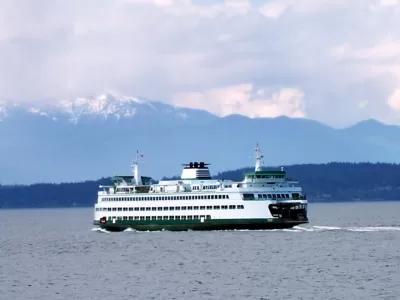
The Washington State Legislature approved a $17 billion, 16-year transportation package that Washington Democrats promise marks the beginning of a new era of transportation planning and funding in the state.
Ryan Packer reports for the Urbanist on the legislative approval for the Move Ahead Washington package, approved in the final hours of the 2022 legislative session and headed for Gov. Jay Inslee's signature. Packer has been reporting on Move Ahead Washington since Democrats in the legislature announced the package of bills on February 8—just a few weeks ago.
"This new era will not represent a complete sea change from the 2015 transportation package, dubbed Connecting Washington, but it will represent several significant shifts in how the state funds mobility investments," according to Packer. While Connecting Washington was packed full of mega-projects, explains Packer, Move Ahead Washington has comparatively few mega-projects, focusing instead on climate- and safety-friendly projects.
"The language in Move Ahead Washington includes a new complete streets requirement for state transportation projects over $500,000 that start design later than this summer," reports Packer. In addition, the Washington State Department of Transportation will be required to "plan, design, and construct facilities providing context sensitive solutions that contribute to network connectivity and safety for pedestrians, bicyclists, and people accessing public transportation" (text from the bill).
The bill supplies $1.45 billion for public transit support grants, including free transit for kids, and doubles the amount of funding for safe routes to school and bicycle and pedestrian projects. Packer stops short of describing the bill as fully transformational, noting that the funding package still provides funding for the widening of I-5 in Vancouver, Washington, including a replacement of the Columbia River Crossing. Packer also lists a few of the other road projects funded by Moving Washington Forward that could end up reaching mega-project levels of spending after all is said and done.
FULL STORY: Welcome to the Move Ahead Washington Era

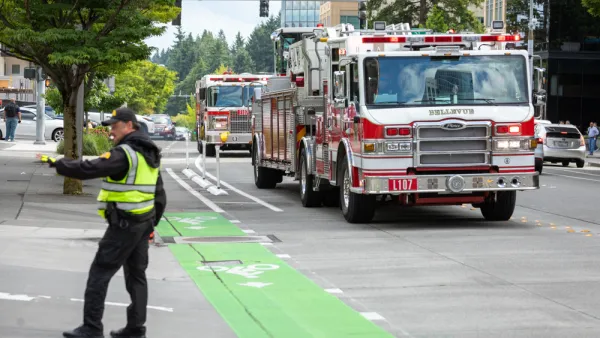
Washington State Moving Ahead With Complete Streets
Move Ahead Washington, a law approved by the Washington State Legislature earlier this year, is expected to have a huge effect on transportation planning and engineering on state-controlled roads.
Report: Caltrans Models, Which Guide Billions in Transportation Funding, are Inaccurate and Outdated
Many of the predictive models used by California’s transportation agency fail to account for post-pandemic travel patterns and induced demand.
Will Voters Fund Transportation Measures in November?
An overview of key transportation-related ballot measures that will be decided in November’s election.

Planetizen Federal Action Tracker
A weekly monitor of how Trump’s orders and actions are impacting planners and planning in America.

The state-sanctioned urbicide of Austin
People don’t kill cities. Freeways do.

US to reduce Colorado River water deliveries to Mexico
A new Colorado Treaty amendment reduces Mexico’s Colorado River water allocation by 250,000 acre feet.

Mamdani overhauls NYC's Vision Zero plan with 100 new policy goals
The overhaul aims to reduce traffic deaths and make streets safer for pedestrians, cyclists and drivers through lower speed limits, new safety infrastructure and more.

Amtrak not solely to blame for New Jersey commuter rail's unreliability, report finds
A new study from the Garden State Initiative found that NJ Transit’s budget grew 20% across a 4 year period, but reliability declined significantly over the same period.

EPA erases limits on planet-warming pollution from power plants
Under Monday’s plan, power plants would still have some limits on how much mercury, arsenic and other contaminants they can emit.

FREE Course: Walkable City 1: Why Walkability?
After describing his path towards focusing on walkability as the essence of good planning, Jeff Speck marches through his five principal reasons for making more walkable places.
Reinventing Malls: Planning Alchemy—Turning Gray Fields Into Gold
The course focuses on the opportunities and imperatives that shape reinvention of mall sites.

Eagle County Government
Harvard University Graduate School of Design
Nashville Planning Department
The Architects Foundation
University of Cincinnati Online
The Pocatello Development Authority
The Urban Renewal Agency of the City of Pocatello
Journal of the American Planning Association