Urban designers are playing the advocate in a Michigan Department of Transportation study that is considering ways to reconfigure U.S. Highway 131 where it curves through Downtown Grand Rapids.


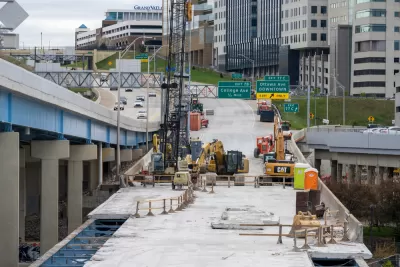
The Michigan Department of Transportation is seeking public feedback on a potential redesign of U.S. Highway 131 in Grand Rapids.
"The state’s fiscal year budget that began Oct. 1 included $10 million to study the reconstruction or reconfiguration of the Wealthy Street interchange that has been referred to as the most dangerous intersection in the state," reports Kate Carlson for MiBiz.
The route is heavily used for goods movement and freight for large industrial uses, but some local advocates monitoring the US-131 Planning and Environmental Linkages (PEL) Study say that safety should be a larger concern in the redesign. The Wealthy Street interchange, for example, is at the southern end of the highway's S-curve through downtown Grand Rapids.
"The concept of redesigning the area surrounding the S-curve dates back decades, with some supporting a redesign that puts the stretch of US-131 at grade, potentially rerouting freight traffic to I-196," explains Carlson.
Soundbites from Ted Lott, principal with Lott3Metz Architecture LLC, and Tim Mroz, vice president of strategic initiatives at The Right Place Inc., are included in the source article.
FULL STORY: MDOT study of U.S. 131 to balance industrial, placemaking concerns

Study: Roundabouts are Primarily in Wealthier Neighborhoods
A North Carolina study sheds light on inequities in road safety interventions.
‘Safe Land Use:’ A Key to Road Safety
How approaching transportation planning through a public health lens can reduce traffic deaths.
Olympia Draft Transportation Plan Zeroes in on Complete Streets, Bike Infrastructure
The city’s comprehensive plan update could signal a shift in transportation planning priorities to a more comprehensive approach that ensures safer roads for all users.

Planetizen Federal Action Tracker
A weekly monitor of how Trump’s orders and actions are impacting planners and planning in America.

The state-sanctioned urbicide of Austin
People don’t kill cities. Freeways do.

US to reduce Colorado River water deliveries to Mexico
A new Colorado Treaty amendment reduces Mexico’s Colorado River water allocation by 250,000 acre feet.

5 New England states march closer to 800 megawatt wind energy project
Securing federal approval for the project may be complicated under the Trump administration, which has historically been hostile towards domestic wind power.

Baltimore to break ground on $50 million Transit Priority Project
The project will bring faster bus trips, safer streets and better bike connections to Baltimore.

Airbnb launches $250 million 'last-dollar financing' housing accelerator, makes first investment in Austin
The company will put $6.4 million towards affordable housing development in Texas’ capital.

FREE Course: Walkable City 1: Why Walkability?
After describing his path towards focusing on walkability as the essence of good planning, Jeff Speck marches through his five principal reasons for making more walkable places.
Reinventing Malls: Planning Alchemy—Turning Gray Fields Into Gold
The course focuses on the opportunities and imperatives that shape reinvention of mall sites.

Eagle County Government
Harvard University Graduate School of Design
Nashville Planning Department
The Architects Foundation
University of Cincinnati Online
The Pocatello Development Authority
The Urban Renewal Agency of the City of Pocatello
Journal of the American Planning Association