New York State's Historic Preservation Office has moved to place the notorious Penn Station on the National Register of Historic Places, potentially upending redevelopment plans.


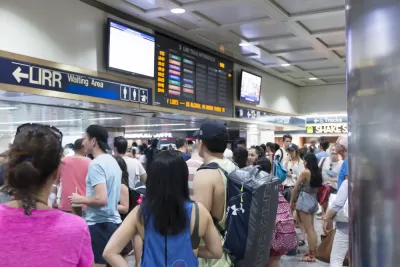
New York City's much maligned Pennsylvania Station, set for massive redevelopment, may get a reprieve thanks to preservationists. As Kriston Capps writes, the state's Historic Preservation Office has proposed adding Penn Station, along with Madison Square Garden and 2 Penn Plaza, to the National Register of Historic Places—effectively slowing the proposed redevelopment of the area and, as Capps writes, "prolonging the misery for the travelers who filter through its begrimed concourses."
Ironically, the demolition of the original, opulent Penn Station was itself a catalyst for the modern historic preservation movement, as activists lamented the loss of the Beaux-Arts style terminal in favor of the current "dank, dark, dim, dismal, depressing, dangerous" incarnation. Most New Yorkers see the 1963 version of Penn Station as a failure, "a delightfully ill-lighted, incomprehensibly organized, low-ceilinged, viewless labyrinth," according to Choire Sicha and Tom Scocca. Yet some preservationists want the governor to reconsider the proposed plans for the station, calling on the state to preserve some of the buildings surrounding the terminal and historical elements in the station itself. The appeal could delay the redevelopment process as officials continue to debate viable plans.
As Capps sees it, the campaign to save such a "hostile" facility in the name of historic preservation should prompt policymakers and advocates to reconsider the "blunt tool that historic preservation has become."
Read the full story: Preservationists Want to Save Penn Station. Yes, That Penn Station.


In New York's Next Penn Station, Function Does Not Always Follow Form
Some of the time and money invested in the visually spectacular Moynihan Station should have been spent looking at how well it actually works for commuters, writes Alon Levy.

New Penn Station design calls for ample public seating — a rare commodity in US public spaces
Amtrak's renderings show benches throughout the station.
New Penn Station design won't move Madison Square Garden
Amtrak and federal officials agreed on a new plan for the station's redesign that may be largely funded by the federal government.

Planetizen Federal Action Tracker
A weekly monitor of how Trump’s orders and actions are impacting planners and planning in America.

California plans to bury El Niño’s downpour
If the state plays its cards right, it may be able to store a billion acre-feet of El Niño’s water in aquifers.

Chicago breaks ground on $3 billion megadevelopment
The new neighborhood, titled Foundry Park, will one day host 3,700 residences.

Satanic place names
From streams and lakes to valleys and canyons, I mapped more than 1,000 places named after the Devil.

California High-Speed Rail Authority CEO resigns after $600,000 scandal
Under Ian Choudri, the authority used taxpayer dollars to fund first class flights and trips to nightclubs.

Want to study the Missouri River? Soon, you may need unanimous approval from 10 states
Legislation would require 10 governors’ permission to study or build projects moving water outside the basin.

FREE Course: Walkable City 1: Why Walkability?
After describing his path towards focusing on walkability as the essence of good planning, Jeff Speck marches through his five principal reasons for making more walkable places.
Reinventing Malls: Planning Alchemy—Turning Gray Fields Into Gold
The course focuses on the opportunities and imperatives that shape reinvention of mall sites.

City of Rosemead
Rutgers University, Edward J. Bloustein School of Planning and Public Policy
One Hundred Miles
Hunter College, City University of New York (CUNY)
The Architects Foundation
University of Cincinnati Online
City of Cambridge
Montrose County
The Pocatello Development Authority