In addition to reducing air pollution and congestion, improving bike infrastructure could save thousands of lives each year, according to new research.


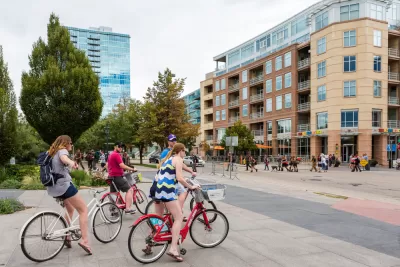
A new study that models the "comprehensive global public health impacts of the mode shift to cycling" found that replacing car trips with bike trips can prevent over 15,000 deaths per year in the U.S. alone, reports Kea Wilson for Streetsblog.
The study analyzed rates of premature deaths due to car crashes and pollution-related disease, as well as how many car trips could be replaced with robust investment in bike infrastructure and other incentives.
Even if just 8 percent of those new bike trips replaced journeys in a car — an extraordinarily conservative estimate, considering that in this hypothetical world, every urban area in the world would be outfitted with Amsterdam-levels of bike lanes — researchers say that 18,589 lives could be saved across the globe, 1,227 of which would be in the U.S. alone.
Meanwhile, even people not using bikes would benefit from improved air quality, reduced congestion, and better overall mobility. "In addition to the impacts modeled in his study, [study author David] Rojas points out that bikeable communities typically have more green space, more real estate to devote to affordable housing, healthy food providers, and other essential services in every neighborhood, and lower levels of noise pollution, all of which have an impact on the physical and mental health of their residents."
FULL STORY: STUDY: Better Bike Policy Could Prevent 15K U.S. Deaths Every Year — And Not Just in Crashes


Paris Bike Boom Leads to Steep Drop in Air Pollution
The French city’s air quality has improved dramatically in the past 20 years, coinciding with a growth in cycling.
2025's 30 Most Bike-friendly Cities
Copenhagenize has released its list of top cities for cyclists. Spoiler alert: the United States doesn’t make the list.

7 Ways Cyclists are Winning in the AI Revolution
For individual cyclists and transportation planners, AI offers some useful tools for understanding bike riders’ behavior and assessing gaps in a city’s bike infrastructure.

Planetizen Federal Action Tracker
A weekly monitor of how Trump’s orders and actions are impacting planners and planning in America.

The state-sanctioned urbicide of Austin
People don’t kill cities. Freeways do.

US to reduce Colorado River water deliveries to Mexico
A new Colorado Treaty amendment reduces Mexico’s Colorado River water allocation by 250,000 acre feet.

Mamdani overhauls NYC's Vision Zero plan with 100 new policy goals
The overhaul aims to reduce traffic deaths and make streets safer for pedestrians, cyclists and drivers through lower speed limits, new safety infrastructure and more.

Amtrak not solely to blame for New Jersey commuter rail's unreliability, report finds
A new study from the Garden State Initiative found that NJ Transit’s budget grew 20% across a 4 year period, but reliability declined significantly over the same period.

EPA erases limits on planet-warming pollution from power plants
Under Monday’s plan, power plants would still have some limits on how much mercury, arsenic and other contaminants they can emit.

FREE Course: Walkable City 1: Why Walkability?
After describing his path towards focusing on walkability as the essence of good planning, Jeff Speck marches through his five principal reasons for making more walkable places.
Reinventing Malls: Planning Alchemy—Turning Gray Fields Into Gold
The course focuses on the opportunities and imperatives that shape reinvention of mall sites.

Eagle County Government
Harvard University Graduate School of Design
Nashville Planning Department
The Architects Foundation
University of Cincinnati Online
The Pocatello Development Authority
The Urban Renewal Agency of the City of Pocatello
Journal of the American Planning Association