The Van Ness Improvement project took almost two decades to cross the finish line, but it's almost there.


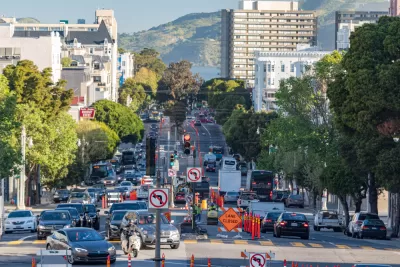
San Francisco has been working on the Van Ness Improvement Project, which includes the controversial addition of bus rapid transit lanes, for a decade and a half. Now a column by Carl Nolte reveals that the long haul is finally on the home stretch in a paywalled article for the San Francisco Chronicle.
First, here's how Nolte sums up the experience of planning, building, and waiting for the Van Ness Improvement project:
Van Ness has been torn up for the city to build an ambitious bus rapid transit corridor 2 miles long from Lombard to Mission streets. Two special lanes, just for buses, were built, along with landscaping, street trees and wider sidewalks. The project was designed to speed up local Muni buses and regional Golden Gate Transit service. It seemed like a great idea when it was in the planning stage. “When it’s done you’ll be thanking us,” Mayor London Breed said when she was president of the Board of Supervisors. But the work took forever. There were delays and cost overruns. It was the mess on Van Ness.
Nolte's exploration of the project includes a tour of the city that reaches back beyond the Roaring 20s, when Van Ness transitioned from the city's "grandest boulevard" to its auto row. Now new development is again transforming the buildings around Van Ness, punctuated by an ambitious rezoning and redevelopment effort at Van Ness and Market called The Hub.
Planetizen's coverage of the Van Ness Improvement project stretches back to 2006. A San Francisco Civil Grand Jury investigated the Van Ness Improvement project, asking where the project went wrong after winning funding from voters in 2003, but waiting until 2016 to break ground and then until about now to complete construction. A separate article by Kevin Truong reports the findings of the Grand Jury's investigation, providing a comprehensive account of the project's long history.
FULL STORY: The bandages are coming off: Check out S.F.’s new Van Ness Avenue

San Francisco To Implement Bus Rapid Transit Service By 2010
While late to adopt bus rapid transit, San Francisco's Muni is planning to bring fully-fledged BRT lines, complete with dedicated lanes, to the city by 2010.
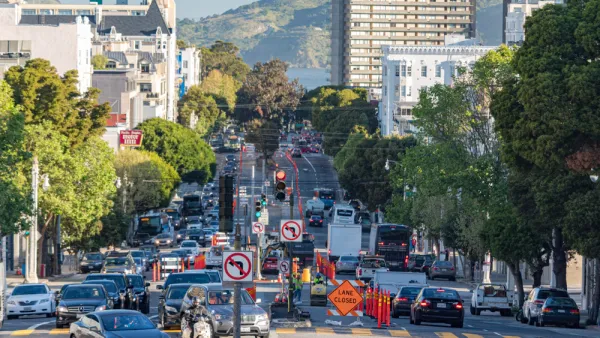
Beleaguered San Francisco Bus Project To Open April 1
San Francisco's much-delayed Van Ness BRT line, expected to speed up travel along the 'grandest boulevard,' has finally received an opening date.
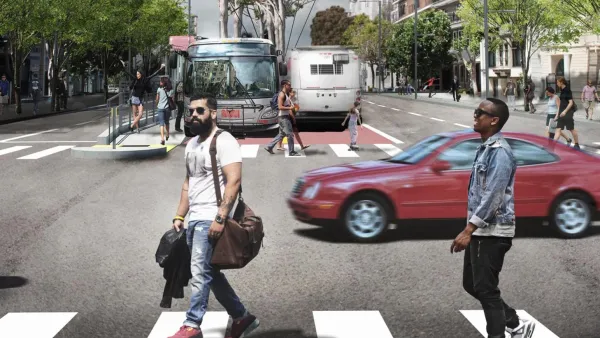
San Francisco's First BRT Line Closer to Opening
The Van Ness Avenue Bus Rapid Transit project will bring the first dedicated BRT corridor to San Francisco, nearly two decades after voters approved the project.

Planetizen Federal Action Tracker
A weekly monitor of how Trump’s orders and actions are impacting planners and planning in America.

The state-sanctioned urbicide of Austin
People don’t kill cities. Freeways do.

US to reduce Colorado River water deliveries to Mexico
A new Colorado Treaty amendment reduces Mexico’s Colorado River water allocation by 250,000 acre feet.

5 New England states march closer to 800 megawatt wind energy project
Securing federal approval for the project may be complicated under the Trump administration, which has historically been hostile towards domestic wind power.

Baltimore to break ground on $50 million Transit Priority Project
The project will bring faster bus trips, safer streets and better bike connections to Baltimore.

Airbnb launches $250 million 'last-dollar financing' housing accelerator, makes first investment in Austin
The company will put $6.4 million towards affordable housing development in Texas’ capital.

FREE Course: Walkable City 1: Why Walkability?
After describing his path towards focusing on walkability as the essence of good planning, Jeff Speck marches through his five principal reasons for making more walkable places.
Reinventing Malls: Planning Alchemy—Turning Gray Fields Into Gold
The course focuses on the opportunities and imperatives that shape reinvention of mall sites.

Eagle County Government
Harvard University Graduate School of Design
Nashville Planning Department
The Architects Foundation
University of Cincinnati Online
The Pocatello Development Authority
The Urban Renewal Agency of the City of Pocatello
Journal of the American Planning Association