The controversial renovation of Penn Station could move forward with a scaled-back plan.


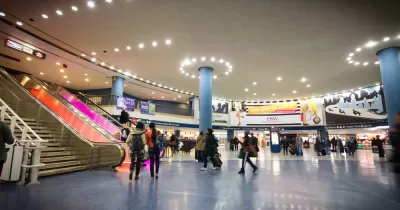
As Justin Davidson reports in Curbed, the long-awaited upgrade to New York's Penn Station could soon inch forward, with Governor Kathy Hochul promising a renovation "as soon as the necessary environmental review and assorted other approvals are complete, and when the money starts to flow from private investment in an office market that may or may not shake off its pandemic-induced torpor, and if Hochul wins reelection or her plan isn’t revised out of existence by her successor," a daunting series of hurdles for a project that has languished for years.
[T]he latest iteration pulls back slightly on the imperial city [former governor] Cuomo had envisioned for the area surrounding Penn Station, cutting some height and bulk from the forest of ten new towers. It makes nearly a third of the megaproject’s 1,800 apartments permanently affordable. New entrances will make the station more porous, and the surrounding streets will become more parklike and pedestrian, less like the fume-choked canyons they are now.
Last December, transit advocates welcomed the opening of the Moynihan Train Hall as a positive–but insufficient–step toward the full renovation of the station, which has not been remodeled since 1968. To significantly improve service, advocates say, Penn Station needs additional tracks and platforms and new tunnels, part of a project labeled Gateway that would increase Penn Station's capacity and accommodate the growing number of commuters that pass through it.
Read the full story: Meet the Newest Next Penn Station
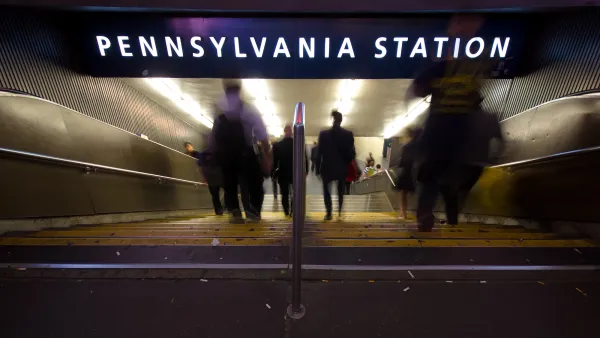
New Penn Station design won't move Madison Square Garden
Amtrak and federal officials agreed on a new plan for the station's redesign that may be largely funded by the federal government.

New Penn Station design calls for ample public seating — a rare commodity in US public spaces
Amtrak's renderings show benches throughout the station.
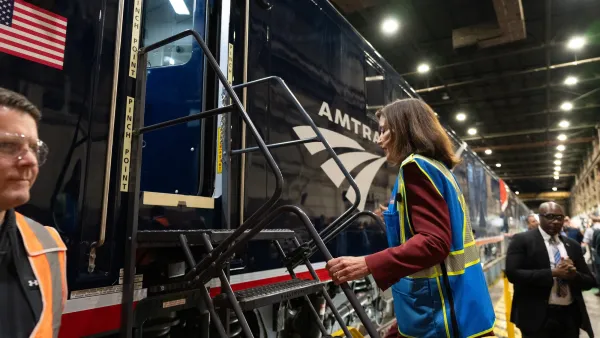
Amtrak to Resume NYC-to-Albany Service After Pressure From Gov. Hochul
Amtrak suspended most service between New York City and the state capital last May as part of work on a project to repair damage from Hurricane Sandy.

Planetizen Federal Action Tracker
A weekly monitor of how Trump’s orders and actions are impacting planners and planning in America.

Eastern Nebraska is running out of electricity
Data centers and electrification are straining eastern Nebraska’s grid, throttling economic development.
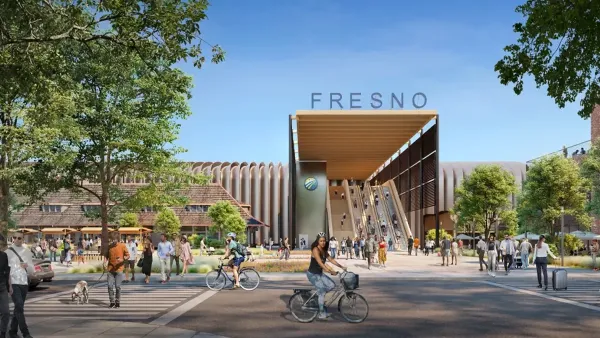
California High-Speed Rail Authority picks trainset manufacturer
The California High-Speed Rail Authority aims to start servicing passengers by 2033.

Massachusetts bogs generate both power, and cranberries
Putting solar panels above farmland is one way Massachusetts is advancing toward its goal of net-zero carbon emissions by 2050.

What could the future of LA transit look like under Raman?
The mayor-elect views broken sidewalks and potholes as crises that can be fixed with better governance.

States are counting on battery farms. Some towns don’t want them.
While fire safety has improved, some communities are still wary.

FREE Course: Walkable City 1: Why Walkability?
After describing his path towards focusing on walkability as the essence of good planning, Jeff Speck marches through his five principal reasons for making more walkable places.
Reinventing Malls: Planning Alchemy—Turning Gray Fields Into Gold
The course focuses on the opportunities and imperatives that shape reinvention of mall sites.

City of Rosemead
Rutgers University, Edward J. Bloustein School of Planning and Public Policy
One Hundred Miles
University of Michigan School for Environment and Sustainability (SEAS)
Hunter College, City University of New York (CUNY)
The Architects Foundation
City of Cambridge
The Pocatello Development Authority
The Urban Renewal Agency of the City of Pocatello