Despite the popularity of intercity bus services, most users have to wait on unshaded sidewalks with none of the amenities of traditional bus depots.


"Bus travel has never gotten the same respect as rail," writes Inga Saffron, "[y]et, pre-pandemic, America’s long-haul buses carried twice the number of passengers as Amtrak." Inter-city buses "remain significantly cheaper than Amtrak and serve far-flung towns that have no train service. For low-income people, car-less single parents, college students, recent immigrants, and other budget-conscious folks living in Philadelphia, intercity buses are often the only way to go." But the companies that provide bus service use city sidewalks or parking lots to pick up riders, avoiding the "hefty docking fees" charged by traditional bus terminals. "A proposal for a more dignified bus terminal on the north side of 30th Street Station, first floated in Amtrak’s 2016 master plan, still hasn’t moved past the idea stage" and will take years to build. Because of this, Saffron argues, Philadelphia should take steps to make the sidewalk stops safe and comfortable.
Most sidewalk stops have "no canopy, no benches, no trash cans and, per usual, no restrooms," despite a recent pledge by city planners to place equity at the forefront of infrastructure decisions. Saffron sees this as an equity issue. "Where’s the equity in a bus stop that offers travelers nowhere to escape the elements?"
Although most policymakers don't see bus travel as an important part of a city's economy, writes Saffron, "bus service to New York, Washington, Penn State and beyond are part of what makes Philadelphia such an attractive place to live and do business." According to Deputy Commissioner Richard Montanez, "the best long-term solution would be for Philadelphia to consolidate all its downtown bus lines in one terminal on the parking lot north of 30th Street Station. But to make that project feasible, PennDot needs to realign the I-76 exit ramp leading to the train station," which could take years.
"The city doesn’t have time to wait," writes Saffron. "Thanks to the demand for life science labs, the area around 30th Street has become the city’s most significant job creator, the engine for its pandemic recovery." Nate Hommel, who oversees planning and design for the University City District (UCD), says the city needs a "comprehensive planning approach to intercity bus transportation" so those who depend on the service don't–literally–get "left out in the cold."
Read the full story: Philly’s failure to improve conditions for intercity bus riders is an equity issue
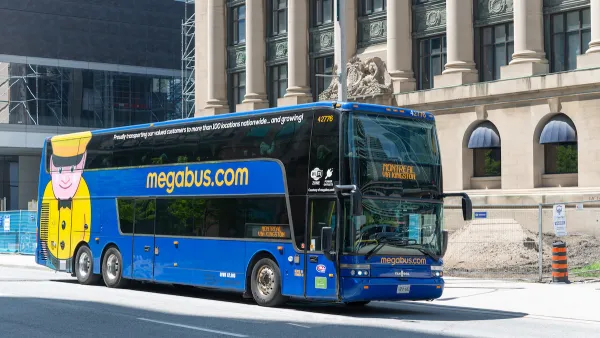
Megabus Owner Files for Bankruptcy
Intercity bus lines in the United States face yet more challenges as a major operator files for bankruptcy, but the company says service continues uninterrupted for now.
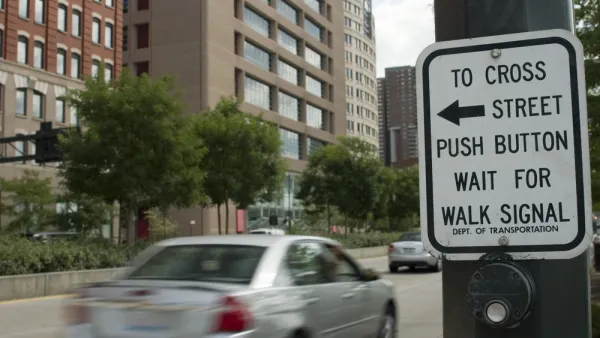
'Beg Buttons' Quietly Appearing at East Bay Crosswalks
Critics of pedestrian crosswalk buttons say the devices, meant to help improve bus speeds, give pedestrians the 'absolute lowest priority' on city streets.
Opinion: To Increase Equity, Make Buses Free
With buses as a dominant transport mode for low-income households and "essential workers," free fares would increase access to economic opportunities and free up limited income for cash-strapped commuters.

Planetizen Federal Action Tracker
A weekly monitor of how Trump’s orders and actions are impacting planners and planning in America.

California plans to bury El Niño’s downpour
If the state plays its cards right, it may be able to store a billion acre-feet of El Niño’s water in aquifers.

Desperate measures: Advocates weigh draining Lake Powell to fill Colorado River
Draining the reservoir could reduce evaporation losses by a couple hundred thousand acre-feet.

US buildings threatened, destroyed by fires set to triple by 2060
Researchers found a high fire risk for socioeconomically vulnerable neighborhoods in the American West.

LA residents may be allowed to paint their own crosswalks
Councilwoman Katy Yaroslavsky put out a motion instructing the Los Angeles Department of Public Transportation to study the feasibility of allowing volunteers to paint crosswalks.

Dallas moves to overhaul its zoning code
The city's zoning reform will allow more multi-family and mixed-use developments.

FREE Course: Walkable City 1: Why Walkability?
After describing his path towards focusing on walkability as the essence of good planning, Jeff Speck marches through his five principal reasons for making more walkable places.
Reinventing Malls: Planning Alchemy—Turning Gray Fields Into Gold
The course focuses on the opportunities and imperatives that shape reinvention of mall sites.

City of Rosemead
Rutgers University, Edward J. Bloustein School of Planning and Public Policy
One Hundred Miles
Hunter College, City University of New York (CUNY)
The Architects Foundation
University of Cincinnati Online
City of Cambridge
Montrose County
The Pocatello Development Authority