With new regulations poised to add 400 new vendors to New York City's streets every year for the next decade, city leaders can look to L.A.'s recent legalization efforts for guidance.


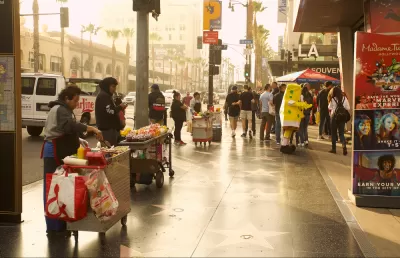
As New York City gets ready to permit hundreds of new street vendors, Alissa Walker suggests some lessons the city can take from Los Angeles. "New York City, where antiquated street vending policies have created a competitive black market for permits, is poised to see a dramatic expansion of its street vendor system for the first time in four decades. Intro 1116, passed earlier this year, adds 400 new permits per year for a decade starting in 2022."
In Los Angeles, the "city council has had an ordinance decriminalizing vendors, backed up by a state law, the Safe Sidewalk Vending Act, passed in 2019. The city’s official permitting process began in January 2020 at a discounted rate of $291; later in the year, the city council made $6 million in grants available to help vendors pay for paperwork and equipment." But many L.A. vendors are trapped in a paradox: in order to pass inspection, vendors are required to have expensive cart setups that many of them can't afford, on top of permitting fees.
Community activists are working to find solutions. "Creating dedicated food hubs could help bring together vendors and mutual-aid groups to become a gathering place where neighborhoods could tackle food insecurity, says Todd Cunningham, the food and wellness organizer at Los Angeles Community Action Network, which is trying to improvise on that model when it serves community meals on Skid Row multiple times per week." Another organizer, "Carla De Paz, senior organizer at Community Power Collective, is working with the city on developing a 'special vending district' permit, that’s somewhere between a special event permit and a farmers market permit, she says."
Despite New York City Mayor de Blasio's promises to support street vendors, "[n]ot only are vendors still getting ticketed, some neighborhood groups, including alliances and BIDs, have found new ways to discourage vendors from selling on their streets, as a recent throwdown at Hudson Yards demonstrated." To succeed, the new permit system should also address "[c]ode compliance, changing laws at the state level, better relationships with regulators," and, critically, support for infrastructure such as communal prep kitchens, or commissaries, which help street vendors meet permit requirements and reduce costs.
FULL STORY: New York City Is About to Add 4,000 Street Vendors. Los Angeles Has Some Ideas to Borrow.

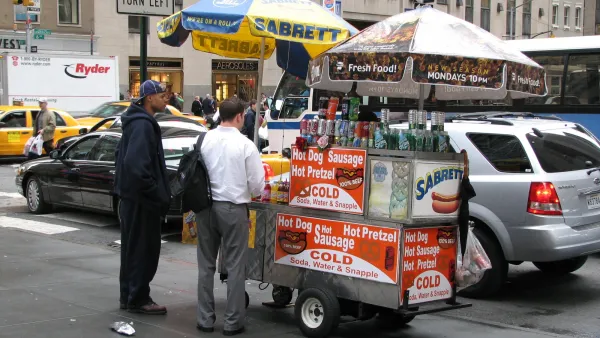
New York's Street Vendors Fight Back Against Displacement
Despite operating on public right-of-way, food vendors claim that developers are pushing them out of established vending spots.
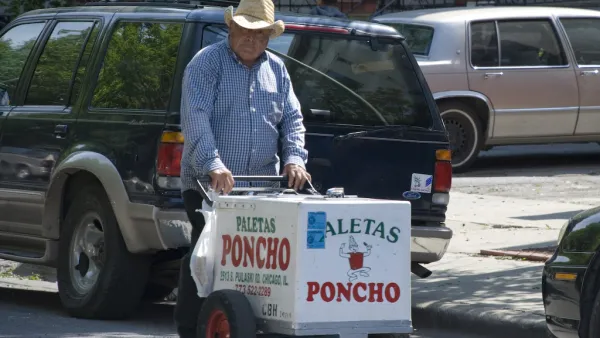
Street Vending Makes Public Spaces Better. Stop Criminalizing It.
While recent crackdowns on street vending suggest it is a problem to be fixed, the reality is that street vendors energize urban spaces and make them more accessible for everyone.
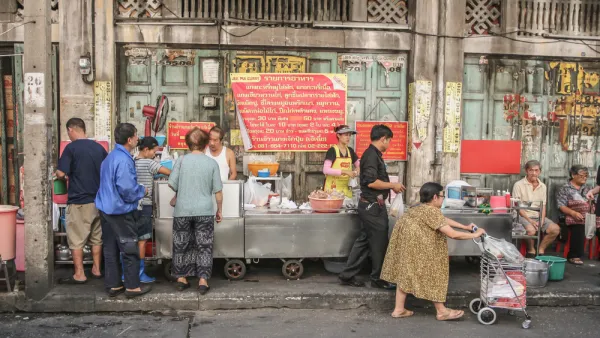
New on Netflix: How Street Vendors Create Vibrant Cities
Street vending has been a contentious issue in many places, but this part of the informal economy is important to the social and economic well-being of cities.

Planetizen Federal Action Tracker
A weekly monitor of how Trump’s orders and actions are impacting planners and planning in America.

The state-sanctioned urbicide of Austin
People don’t kill cities. Freeways do.

US to reduce Colorado River water deliveries to Mexico
A new Colorado Treaty amendment reduces Mexico’s Colorado River water allocation by 250,000 acre feet.

5 New England states march closer to 800 megawatt wind energy project
Securing federal approval for the project may be complicated under the Trump administration, which has historically been hostile towards domestic wind power.

Baltimore to break ground on $50 million Transit Priority Project
The project will bring faster bus trips, safer streets and better bike connections to Baltimore.

Airbnb launches $250 million 'last-dollar financing' housing accelerator, makes first investment in Austin
The company will put $6.4 million towards affordable housing development in Texas’ capital.

FREE Course: Walkable City 1: Why Walkability?
After describing his path towards focusing on walkability as the essence of good planning, Jeff Speck marches through his five principal reasons for making more walkable places.
Reinventing Malls: Planning Alchemy—Turning Gray Fields Into Gold
The course focuses on the opportunities and imperatives that shape reinvention of mall sites.

Eagle County Government
Harvard University Graduate School of Design
Nashville Planning Department
The Architects Foundation
University of Cincinnati Online
The Pocatello Development Authority
The Urban Renewal Agency of the City of Pocatello
Journal of the American Planning Association