The Urbanist's editorial board calls for an end to highway widening and an increased focus on walking, biking, and transit.


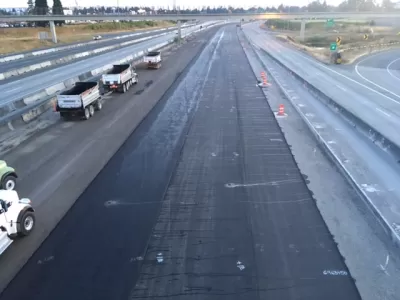
The editorial board of The Urbanist joins a "clarion call led by the Disability Mobility Initiative and the Front and Centered Coalition: Washington State must cease spending on new highways." In an editorial published on March 18, the board cites "more pressing needs" for the state "around making our roads safe for people walking, rolling, and biking and boosting transit service to lower climate emissions" and avoid a "climate death spiral."
The board criticizes three transportation and infrastructure proposals currently in the Washington state legislature, particularly Senator Steve Hobbs' "Forward Washington" package, which, according to the authors, "in particular represents the wrong approach. The project list is heavily weighted toward highway widening." While "Governor Inslee emphasized a maintenance-first approach…he also highlighted the need for highway expansion projects." The editorial argues that "adding lanes and interchanges is clearly an expansion of highway infrastructure even if it’s dressed up with tolling or carpool lanes." Maintenance is important, but "what does maintenance first mean if billions and billions more dollars are invested in highway expansion?"
According to the authors, Washington should prioritize different strategies to meet its climate change and transportation goals. "Until our state can meet its climate goals and its Vision Zero pledge to end traffic deaths, adding more highway capacity would only be doubling down on a failing strategy and welcoming more carnage."
FULL STORY: No New Highways Is a 21st Century Imperative

Federal Carbon Reduction Funds Could Finance Highway Projects in Texas
Transit advocates say the state’s carbon reduction strategy reveals a continued preference for car-oriented infrastructure.
How Much Does the President Influence Transportation Funding?
Whether it’s a preference for highway expansion, passenger rail, or bike infrastructure, different administrations can shift grantmaking priorities at the federal level.
Seattle Mayor Raises Transportation Levy by $100 Million
The proposal sent to City Council includes more funding for multimodal transportation and road safety.

The state-sanctioned urbicide of Austin
People don’t kill cities. Freeways do.

US to reduce Colorado River water deliveries to Mexico
A new Colorado Treaty amendment reduces Mexico’s Colorado River water allocation by 250,000 acre feet.

New Jersey’s second-largest city bans standalone data centers
Jersey City will continue to allow co-location facilities, such as those meant for research institutions that store their own data.

Amtrak not solely to blame for New Jersey commuter rail's unreliability, report finds
A new study from the Garden State Initiative found that NJ Transit’s budget grew 20% across a 4 year period, but reliability declined significantly over the same period.

EPA erases limits on planet-warming pollution from power plants
Under Monday’s plan, power plants would still have some limits on how much mercury, arsenic and other contaminants they can emit.

Phoenix announces new on-demand transit service, more frequent RAPID buses
Both new services will launch in October, and are part of Phoenix's Project Effective Access Solutions for Easing Congestion.

FREE Course: Walkable City 1: Why Walkability?
After describing his path towards focusing on walkability as the essence of good planning, Jeff Speck marches through his five principal reasons for making more walkable places.
Reinventing Malls: Planning Alchemy—Turning Gray Fields Into Gold
The course focuses on the opportunities and imperatives that shape reinvention of mall sites.

Eagle County Government
Harvard University Graduate School of Design
Nashville Planning Department
The Architects Foundation
University of Cincinnati Online
The Pocatello Development Authority
The Urban Renewal Agency of the City of Pocatello
Journal of the American Planning Association