The proposal sent to City Council includes more funding for multimodal transportation and road safety.


Acknowledging calls for more funding for road safety and multimodal transportation, Seattle Mayor Bruce Harrell added $100 million to his proposed transportation levy aimed at sidewalks, bike lanes, and public transit.
As Ryan Packer explains in The Urbanist, “The City is highly reliant on levy funding, as Move Seattle accounts for about 30% of the overall budget at the Seattle Department of Transportation (SDOT).”
The second draft of the levy proposal shifts more spending toward multimodal infrastructure, committing to build 250 blocks of sidewalks by 2028. The plan would also invest $20 million in transit improvements, $5 million in pedestrian lighting, and $3 million in transit security. “Another $20 million was added in bike infrastructure funding, though the levy still lacks any concrete goal around how exactly that funding will be used.” The mayor said this is intended to “bake in a little flexibility for the city councilors to know their sidewalks, their streets, their cycle networks.”
The levy proposal will go before Seattle voters this summer.
Read the full story: Harrell Adds $100 Million to Transportation Levy Proposal, Sends to City Council

Seattle Mobility Advocates Say City Should Triple Transportation Levy
A measure set to go before voters in November will fund road safety and mobility projects, but advocates say a much bigger investment is required to meet the city’s needs.

L.A. Times: California Must Shift Transportation Spending Priorities
Despite its ambitious emissions reduction goals, California continues to spend a majority of transportation funds on car-centric infrastructure.
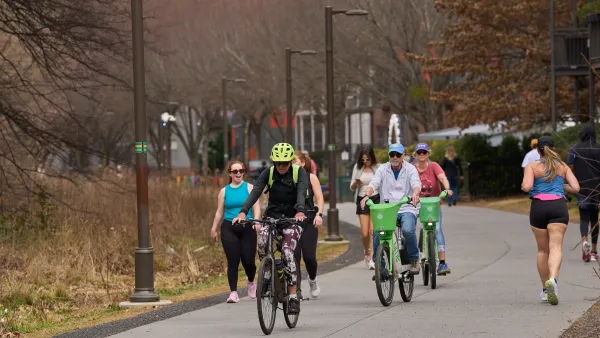
Atlanta could add dedicated bike lane to Beltline
A city councilmember says a dedicated lane would prevent conflicts between cyclists and pedestrians, but others worry it would impede efforts to build transit along the Beltline.

Planetizen Federal Action Tracker
A weekly monitor of how Trump’s orders and actions are impacting planners and planning in America.

California plans to bury El Niño’s downpour
If the state plays its cards right, it may be able to store a billion acre-feet of El Niño’s water in aquifers.

Chicago breaks ground on $3 billion megadevelopment
The new neighborhood, titled Foundry Park, will one day host 3,700 residences.

California High-Speed Rail Authority CEO resigns after $600,000 scandal
Under Ian Choudri, the authority used taxpayer dollars to fund first class flights and trips to nightclubs.

Want to study the Missouri River? Soon, you may need unanimous approval from 10 states
Legislation would require 10 governors’ permission to study or build projects moving water outside the basin.

Desperate measures: Advocates weigh draining Lake Powell to fill Colorado River
Draining the reservoir could reduce evaporation losses by a couple hundred thousand acre-feet.

FREE Course: Walkable City 1: Why Walkability?
After describing his path towards focusing on walkability as the essence of good planning, Jeff Speck marches through his five principal reasons for making more walkable places.
Reinventing Malls: Planning Alchemy—Turning Gray Fields Into Gold
The course focuses on the opportunities and imperatives that shape reinvention of mall sites.

City of Rosemead
Rutgers University, Edward J. Bloustein School of Planning and Public Policy
One Hundred Miles
Hunter College, City University of New York (CUNY)
The Architects Foundation
University of Cincinnati Online
City of Cambridge
Montrose County
The Pocatello Development Authority