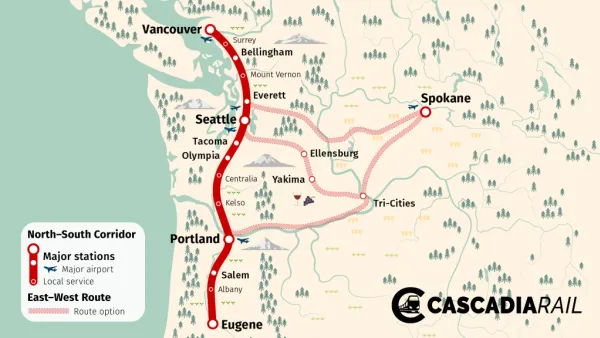
A regional high-speed rail network could be coming to the Pacific Northwest, linking cities from Oregon to British Columbia.



A report from the Washington State Department of Transportation(WSDOT) encourages the development of high-speed rail in the region and suggests a framework for bringing ultra-high-speed ground transportation (UHSGT) to the Pacific Northwest.
Leaders from Oregon and British Columbia praised the report as a positive step toward regional collaboration, citing the potential for job growth and economic development. Although "a plan to design a plan" doesn't exactly inspire confidence, writes Doug Trumm, designing a regional system will require close cooperation across state and national lines and coordination with other transit agencies to ensure useful connections to existing and future transit options. The WSDOT report outlines steps in three broad areas: governance, strategic engagement, and funding and finance, with actionable steps to bring the project closer to reality.
In the short term, the plan requires an enabling agreement and the creation of a funded coordinating entity to move the project forward. Stakeholder engagement with indigenous communities and tribal leaders will be particularly important in a region with a long history of colonization and displacement by transportation networks—most notably the transcontinental railroad. The three participating jurisdictions and HSR supporter Microsoft (which sees benefit from improving transportation in its home state) have pledged to support the project. Once planning efforts are underway, the new agency will be responsible for a funding plan to cover the estimated $24 to $42 billion cost of a Portland-to-Vancouver rail system.
FULL STORY: Report Lays Out Framework for a Cascadia High-Speed Rail Authority

Cascadia High-Speed Rail Corridor Seeking Federal Funding
The state of Washington is hoping federal infrastructure funding can pay for $198 million of the $348 million necessary to plan the Cascadia High-Speed Rail project.

Economic Stimulus: Another Chance for High-Speed Rail in the U.S.?
High-speed rail advocates in the Pacific Northwest are pushing for a high-speed link between Vancouver, Seattle, and Portland to be part of future economic stimulus spending in the United States.
Report Makes Business Case for Vancouver-to-Portland High Speed Rail
Washington State released a report detailing the business case for connecting Seattle to Portland and Vancouver by high-speed rail.

Planetizen Federal Action Tracker
A weekly monitor of how Trump’s orders and actions are impacting planners and planning in America.

The state-sanctioned urbicide of Austin
People don’t kill cities. Freeways do.

US to reduce Colorado River water deliveries to Mexico
A new Colorado Treaty amendment reduces Mexico’s Colorado River water allocation by 250,000 acre feet.

5 New England states march closer to 800 megawatt wind energy project
Securing federal approval for the project may be complicated under the Trump administration, which has historically been hostile towards domestic wind power.

Baltimore to break ground on $50 million Transit Priority Project
The project will bring faster bus trips, safer streets and better bike connections to Baltimore.

Airbnb launches $250 million 'last-dollar financing' housing accelerator, makes first investment in Austin
The company will put $6.4 million towards affordable housing development in Texas’ capital.

FREE Course: Walkable City 1: Why Walkability?
After describing his path towards focusing on walkability as the essence of good planning, Jeff Speck marches through his five principal reasons for making more walkable places.
Reinventing Malls: Planning Alchemy—Turning Gray Fields Into Gold
The course focuses on the opportunities and imperatives that shape reinvention of mall sites.

Eagle County Government
Harvard University Graduate School of Design
Nashville Planning Department
The Architects Foundation
University of Cincinnati Online
The Pocatello Development Authority
The Urban Renewal Agency of the City of Pocatello
Journal of the American Planning Association