With the signs of climate change all around, the effects of the Trump administration's environmental regulation rollbacks look increasingly dire.


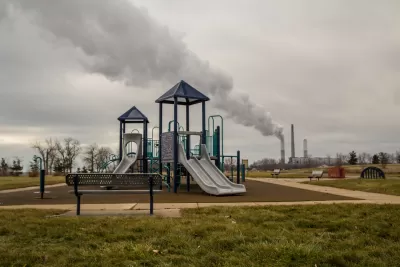
Nadja Popovich and Brad Plumer share the news about a new report by the Rhodium Group that quantifies the effect of the Trump administration's environmental rollbacks in terms of climate emissions. In total, the Trump administration's environmental rollbacks will emit an additional 1.8 billion metric tons of climate emissions equivalent to carbon dioxide by 2035.
The article includes infographics that provides scale to the data revealed by the report, including a breakdown of emissions by type—methane for oil and gas operations, methane for landfills, hydrofluorocarbons, fuel efficiency standards, and removing California's vehicle emissions authority. The two largest sources of emissions enabled by Trump administration policies are the methane for oil and gas operations, at 592 million metric tons of carbon dioxide equivalent, and the California vehicle authority, at 573 million metric tons.
For perspective, Popovich and Plumer report that the total 1.8 billion metric tons of carbon is more than the combined emissions of Canada, Germany, and Britain. The article also notes that the report only accounts for some of the potential effects of Trump administration environmental policies: more changes are still in the works, like the Energy Department's "plans to change federal rules that would have required more efficient light bulbs," and the decision to repeal and replace the Obama-era Clean Power Plan. "It is unclear what effects [the Clean Power] move will ultimately have," according to Popovich and Plumer. "Many states have been retiring coal plants and shifting to cleaner alternatives recently — because of the falling cost of natural gas, wind and solar power — and were already beating the targets set by the Obama-era rule."
Additional coverage of the Rhodium report is available from Ben German for Axios.
Read the full story: What Trump’s Environmental Rollbacks Mean for Global Warming
White House Ends Talks with California Over Fuel Efficiency Standards
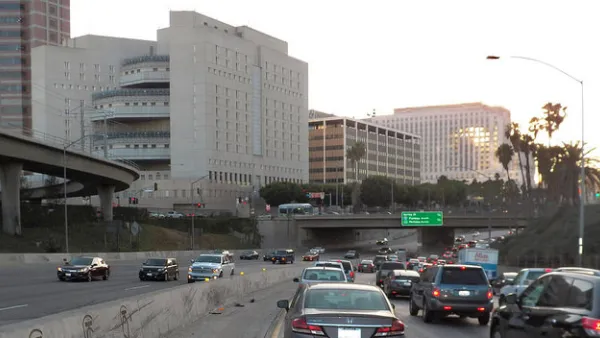
Ending the talks means litigation will have to settle the conflict over the two standards: California and 12 other states continue to use the Obama-era standard of 36 mpg by 2025, while the administration's rule freezes standards at 2020, or 29 mpg.
Trump Administration Proposes to Freeze Fuel Economy Standards at 2020 Level
On Thursday, the U.S. DOT and U.S. EPA announced one of the Trump administration's most consequential rollbacks of environmental and efficiency regulations that will have a detrimental effect on climate change, air pollution, and oil consumption.

Rollback of Fuel Efficiency Standards Announced by EPA
EPA Administrator Scott Pruitt announced Monday that his agency is siding with auto manufacturers and relaxing greenhouse gas emission standards for new cars and light trucks.

Planetizen Federal Action Tracker
A weekly monitor of how Trump’s orders and actions are impacting planners and planning in America.

Eastern Nebraska is running out of electricity
Data centers and electrification are straining eastern Nebraska’s grid, throttling economic development.

Washington state to charge fee to drivers with fuel-efficient cars
Revenue from the fee will go towards supporting the state’s highways.

Instead of building new housing, LA developers are turning mansions into mega-mansions
In the richest areas, the number of houses valued at $30 million with demolition permits has skyrocketed since 2018.

Illinois considers spending $1 billion in taxpayer money on data center
A quantum computing campus and data center are currently under construction in Chicago.

As development costs rise, Boston moves to lessen affordable housing requirements
The Boston Zoning Commission and the City Council still need to approve Boston Mayor Michelle Wu’s proposed changes

FREE Course: Walkable City 1: Why Walkability?
After describing his path towards focusing on walkability as the essence of good planning, Jeff Speck marches through his five principal reasons for making more walkable places.
Reinventing Malls: Planning Alchemy—Turning Gray Fields Into Gold
The course focuses on the opportunities and imperatives that shape reinvention of mall sites.

City of Charlotte
City of Rosemead
Rutgers University, Edward J. Bloustein School of Planning and Public Policy
University of Michigan School for Environment and Sustainability (SEAS)
Hunter College, City University of New York (CUNY)
The Architects Foundation
City of Cambridge
The Pocatello Development Authority
The Urban Renewal Agency of the City of Pocatello