For many Americans living through the social distancing and stay-at-home-orders of 2020, supporting local businesses means cutting out the tech middle man.


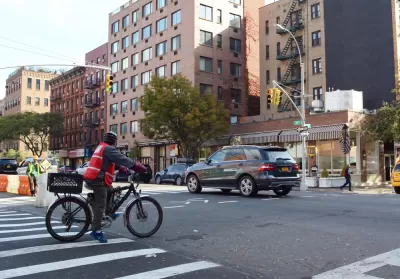
"To help local businesses, many of which are on the edge of going under, some people here are going out of their way to call restaurants instead of using fee-charging delivery apps," reports Heather Kelly.
Kelly's coverage of the delivery app revolt centers in the San Francisco bay Area—where residents opting out of the mobile app delivery game are opting out of many businesses headquartered in nearby cities. The terrible economic consequences of the pandemic have revealed the huge costs restaurants pay to play the delivery app game.
Giuseppe Badalamenti, owner of Chicago Pizza Boss and a restaurant consultant, posted a receipt from another restaurant he was working with that showed seemingly exorbitant fees from Chicago-based Grubhub. What started as $1,042.63 in food sales was reduced to $376.54 after Grubhub fees for delivery, commission, processing and promotions.
According to the article, customers aren't the only ones choosing to circumvent delivery apps by picking up directly from local businesses, some delivery professionals have also started taking personal delivery jobs.
The delivery app business has noticed, and some companies, like DoorDash and grubHub have changed their fee structures and have launched initiatives to provide direct support to local businesses. And despite the growing revolt, delivery services have done more business than ever since most parts of the country started staying at home in March.
Read the full story: To save their neighborhood small businesses, people are rebelling against delivery apps


New Google Map Layer Shows COVID-19 Infection Rates
A new layer showing the seven-day average of confirmed COVID-19 cases started rolling out to Android and iPhones last week.
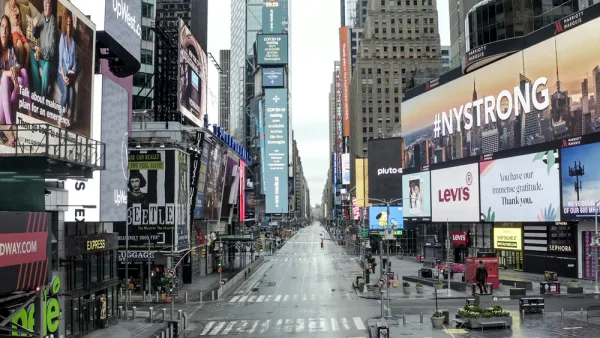
Biden Signs Legislation Ending Covid 19 National Emergency
The Covid 19 national emergency enacted by then-President Donald Trump in March 2020 was officially ended on Monday by President Joe Biden.
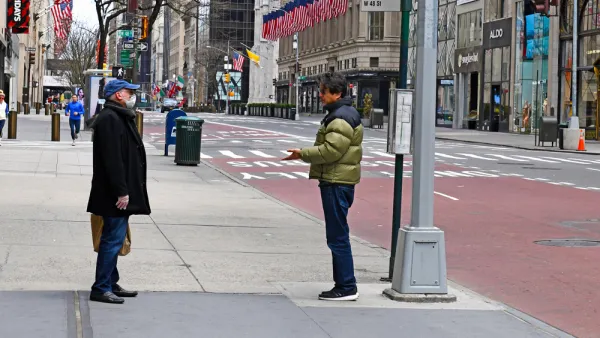
Friday Eye Candy: Covid-19, Then and Now
The New York Times compared images from readers portraying similar scenes in 2020 and 2022.

Planetizen Federal Action Tracker
A weekly monitor of how Trump’s orders and actions are impacting planners and planning in America.

Amtrak, CN end decades-long dispute with eight-year agreement
The new operating agreement establishes an updated framework for the companies to work together, including processes to resolve disputes.

Judges permit Denver to divert 77,000 acre feet from the Colorado River for reservoir expansion
Overuse and climate change have caused the Colorado River’s water levels to plummet.

Boston has spent millions making the Green Line more accessible — and there’s no end in sight
While the city has invested millions into expanding and adding platforms to the Green Line to make it more accessible, new train cars set to arrive next year will be too tall for disabled passengers to board without raising the current platforms.

Idaho may see an 18% drop in federal surface transit funding — the largest estimated cut in the US
Transit systems in rural communities are much more reliant on federal funding to provide their services.

How ‘post-disaster gentrification’ alters neighborhoods after natural calamities
After hurricanes, fires or other calamities, the original residents of a community are often replaced by younger, wealthier residents.

FREE Course: Walkable City 1: Why Walkability?
After describing his path towards focusing on walkability as the essence of good planning, Jeff Speck marches through his five principal reasons for making more walkable places.
Reinventing Malls: Planning Alchemy—Turning Gray Fields Into Gold
The course focuses on the opportunities and imperatives that shape reinvention of mall sites.

City of Wisconsin Rapids
Harvard University Graduate School of Design
KFH Group Inc.
The Architects Foundation
University of Cincinnati Online
The Pocatello Development Authority
The Urban Renewal Agency of the City of Pocatello