A plan to widen Interstate 270 in Maryland was approved earlier this year under the condition that the state also study a plan to build a monorail along the route.



Dan Malouf writes: "Maryland will officially study a proposal to build a monorail along I-270, from Shady Grove to Frederick. Let’s examine whether that’s a crazy idea, or if monorail is a legitimate and practical possibility."
As noted by Malouf, the monorail feasibility plan is a component of a larger plan to widen I-270, approved by the Maryland Public Works Board in June 2019.
"If built, the foundation’s plan would see a 27-mile monorail, mostly along I-270, with six stops: Frederick, Urbana, Comsat (Clarksburg), Germantown, Metropolitan Grove, and Shady Grove. They say the elevated monorail would take 31 minutes to get from Frederick to Shady Grove, carry between 39,000 and 55,000 riders per day, and cost around $3.4 billion to build," explains Malouf.
Malouf digs into the strengths (e.g., lighter, cheaper, and aesthetic above ground) and weaknesses (e.g., must be elevated, can't switch tracks, potentially more expensive).
The High Road Foundation, the advocates behind the proposal, "seem most keen to provide a direct transit connection between Frederick and Montgomery County, according to Malouf, so the article also considers the potential of other modes (e.g., bus rapid transit, Metro rail, light rail, Diesel Multiple Units) to meet the need.
Read the full story: Is a monorail on I-270 in Maryland a crazy idea? Here are its legit pros & cons

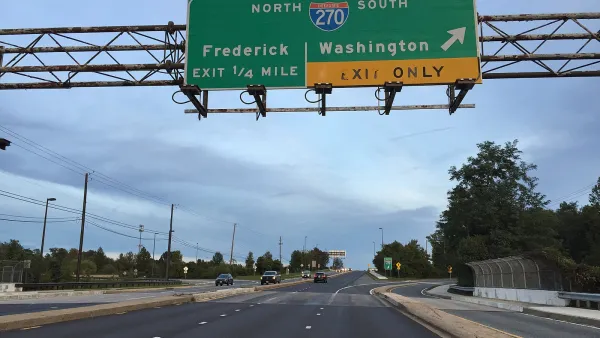
Study: Montgomery County Needs Dedicated Bus Lanes, Rail Extension
A report from Montgomery County planners prioritizes the need for a robust network of bus lanes and the extension of the Red Line to accommodate the region's growing population and reduce car trips and congestion.
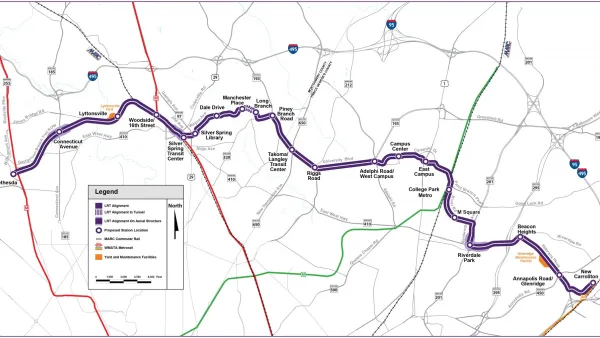
Maryland's Purple Line Clears Final Legal Obstacle
A third lawsuit tried to halt the Purple Line light rail project in Maryland, but it was just the latest lawsuit to get tossed by a judge.
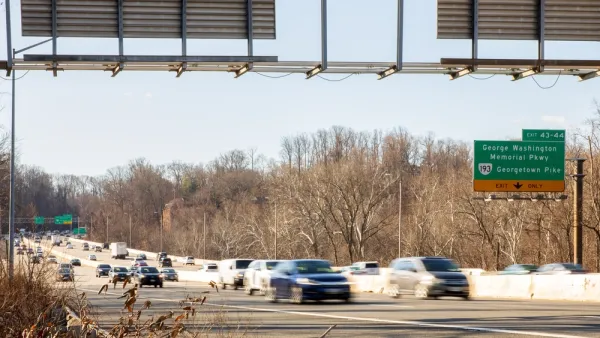
Maryland Toll Lane Plan Gains Federal Approval
In a victory for Governor Larry Hogan, who has championed the project, the Federal Highway Administration is allowing the Beltway expansion project to move ahead.

Planetizen Federal Action Tracker
A weekly monitor of how Trump’s orders and actions are impacting planners and planning in America.

California plans to bury El Niño’s downpour
If the state plays its cards right, it may be able to store a billion acre-feet of El Niño’s water in aquifers.

Desperate measures: Advocates weigh draining Lake Powell to fill Colorado River
Draining the reservoir could reduce evaporation losses by a couple hundred thousand acre-feet.

California city breaks ground on transit connector
The project includes three mobility hubs and a pedestrian bridge.

After public outcry, Massachusetts city releases housing development tracker
Cambridge’s tracker currently shows 250 housing projects in various stages of development.

40 years after approval, Chicago breaks ground on new park
The park honors Jean Baptiste Point du Sable, the city’s first permanent non-native settler.

FREE Course: Walkable City 1: Why Walkability?
After describing his path towards focusing on walkability as the essence of good planning, Jeff Speck marches through his five principal reasons for making more walkable places.
Reinventing Malls: Planning Alchemy—Turning Gray Fields Into Gold
The course focuses on the opportunities and imperatives that shape reinvention of mall sites.

City of Rosemead
Rutgers University, Edward J. Bloustein School of Planning and Public Policy
One Hundred Miles
Hunter College, City University of New York (CUNY)
The Architects Foundation
University of Cincinnati Online
City of Cambridge
Montrose County
The Pocatello Development Authority