Gov. Gavin Newsom vetoed a unique road pricing bill due to concerns that charging a fee would limit access to driving on two blocks of Lombard Street, a popular tourist attraction in San Francisco that is severely congested.


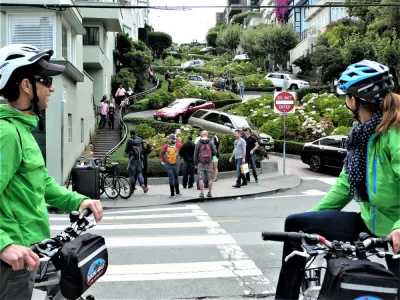
Assembly Bill 1605, the "Crooked Street Reservation and Pricing Program," was not a prototypical congestion or cordon pricing bill that would permit a Manhattan-like program, but it would have forced tourists to pay to drive on a public road, not unlike motorists being charged to park on a public street. Unlike parking charges, though, state legislation is required in California before cities can charge driving fees on roads they manage.
With over a million vehicles driving the “crooked street" section of Lombard Street located between Leavenworth Street and Hyde Street annually, the San Francisco County Transportation Authority devised a Lombard Crooked Street project and settled on a reservation and pricing program that Assemblyman Phil Ting introduced as legislation. The bill passed the legislature last month.
Kate Larsen, reporting from Lombard Street for the local ABC network affiliate (see the video in source article), notes that the critical component of the plan was not the fee, but the reservation element.
"The issue is not the fee, the issue is limiting the number of permits sold, to the capacity of the street," said Steve Taber, the transportation chair of the Russian Hill Neighbors association.
Taber is disappointed the Governor rejected the bill, since he views the reservations, not the fees, as the real solution to reducing congestion in his neighborhood. "You could give them away and you would still have a viable program because you would limit them."
Of course, with traditional highway congestion pricing, it's all about the fee, which increases with the level of congestion, often dynamically, meaning the toll would change every six minutes or so, ensuring that speeds do not drop below the federally mandated 45 mph.
Veto message
"As the former county supervisor representing this neighborhood, I am acutely aware of the need to address congestion and safety around Lombard Street," wrote Gov. Newsom, the former San Francisco mayor from 2004 to 2011, in his Oct. 12 veto message [pdf].
However, the pricing program proposed in this bill creates social equity issues. Access to this iconic attraction should be available to all, regardless of their ability to pay.
The fact that social equity was the key reason for the governor's veto does not augur well for real cordon pricing programs like those being considered for downtown San Francisco and Los Angeles. Social equity has proven to be a major challenge for the Los Angeles cordon pricing program. A "Road Pricing Equity Report and Toolkit" was prepared by a Bay Area nonprofit to deal with overcoming the controversial pricing aspect of cordon charges.
"I’m disappointed that the Governor vetoed AB 1605," Ting responded in an emailed statement.
Lombard Street draws up to 17,000 visitors per day on busy weekends and neither the presence of parking enforcement officers, nor the closure of the crooked segment has helped to alleviate congestion. The city is running out of options. I look forward to working with the Governor and local residents to resolve this public safety and quality of life issue.
Related in Planetizen on cordon pricing programs and legislation in California
-
Urban Congestion Pricing Might Finally Come to California, September 9, 2019
- California Unlikely to Follow New York in Allowing Urban Street Tolling, March 29, 2019
Hat tip to the International Bridge, Tunnel and Turnpike Association Smart Brief.
FULL STORY: Governor Newsom vetoes toll system for San Francisco's iconic Lombard Street

Urban Congestion Pricing Might Finally Come to California
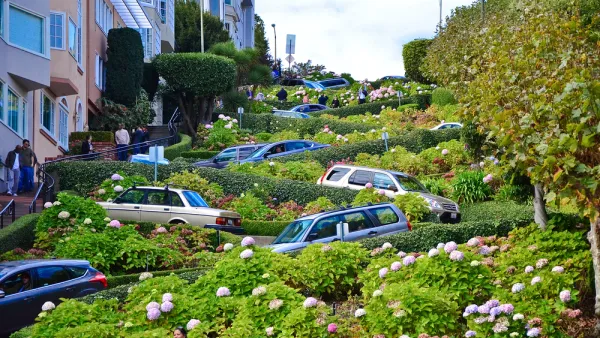
If Gov. Gavin Newsom signs legislation by San Francisco Assemblyman Phil Ting, motorists who want to drive the 'world's most crooked street,' a huge tourist draw, will be forced to participate in a pilot 'reservation and pricing program.'
Congestion Pricing Has Mayoral Support in San Francisco
Additional disincentives for driving (i.e., congestion pricing and new parking fees) are on the mayor's agenda in San Francisco.
Another Bay Area City Considers Urban Tolling
East Palo Alto has long suffered the toll that transbay traffic has imposed on this gateway to Silicon Valley from the East Bay in the form of air pollution and traffic congestion. Now the city is considering tolling the traffic.

Planetizen Federal Action Tracker
A weekly monitor of how Trump’s orders and actions are impacting planners and planning in America.

The state-sanctioned urbicide of Austin
People don’t kill cities. Freeways do.

US to reduce Colorado River water deliveries to Mexico
A new Colorado Treaty amendment reduces Mexico’s Colorado River water allocation by 250,000 acre feet.

Mamdani overhauls NYC's Vision Zero plan with 100 new policy goals
The overhaul aims to reduce traffic deaths and make streets safer for pedestrians, cyclists and drivers through lower speed limits, new safety infrastructure and more.

Amtrak not solely to blame for New Jersey commuter rail's unreliability, report finds
A new study from the Garden State Initiative found that NJ Transit’s budget grew 20% across a 4 year period, but reliability declined significantly over the same period.

EPA erases limits on planet-warming pollution from power plants
Under Monday’s plan, power plants would still have some limits on how much mercury, arsenic and other contaminants they can emit.

FREE Course: Walkable City 1: Why Walkability?
After describing his path towards focusing on walkability as the essence of good planning, Jeff Speck marches through his five principal reasons for making more walkable places.
Reinventing Malls: Planning Alchemy—Turning Gray Fields Into Gold
The course focuses on the opportunities and imperatives that shape reinvention of mall sites.

Eagle County Government
Harvard University Graduate School of Design
Nashville Planning Department
The Architects Foundation
University of Cincinnati Online
The Pocatello Development Authority
The Urban Renewal Agency of the City of Pocatello
Journal of the American Planning Association