Planetizen has collected local and national news on a massive, ongoing environmental and infrastructure story in Northern California. There are maps to keep track of the scope of planned power outages.


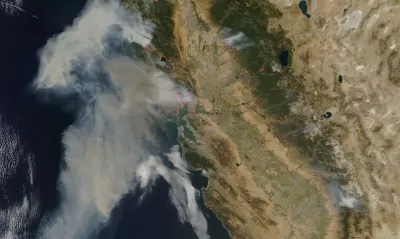
The massive utility PG&E, which provides natural gas and electricity to almost two-thirds of the state of California, is taking a new approach to wildfire risk: it's preemptively shutting off power to hundreds of thousands of customers during a high wind event to prevent the kind of catastrophic fire that destroyed the city of Paradise in 2018 and killed 88 people trapped by the flames.
Critics of the plan say the actions are the result of years of neglect by the investor owned utility, and will do more to protect PG&E from liability than prevent wildfires.
For local news on the subject, see coverage by Michael Cabanatuan, J.D. Morris, and Lauren Hernández for the San Francisco Chronicle, providing the earliest details of the promised power outage.
"Pacific Gas and Electric Co. shut off power to more than 141,000 Bay Area customers before dawn Wednesday in the first of an expected wave of blackouts intended to avert a destructive wildfire like those that took dozens of lives and destroyed thousands of homes over the past two years."
On Wednesday morning, Sonoma County was dealing with the largest number of power outages; 67,000 residences and businesses had lost power. According to the article, PG&E expects to cut power to 800,000 customers in the next few days, starting in more northern service areas before heading south.
The San Francisco Chronicle is also providing a map of power outages to keep track of the geographic scope of the emergency in real time. There is also a hashtag on Twitter, #PSPS, for a collection of insights, breaking news, and personal accounts of the power outage.
For additional local coverage of the outages, see an article by Camille Von Kaenel for the Chico Enterprise Record (Chico is the largest city located proximate to Paradise, and has dealt with the displacement repercussions of the Camp Fire). According to Kaenel, the power outages reveals ongoing gaps in the electricity infrastructure in Butte County, a year after the Camp Fire.
Many Northern Californians on social media on Tuesday night noted a relative lack of attention to the developing story among national and East Coast media outlets, but outlets from coast to coast picked up the story today. Hannah Fry, Joseph Serna, and Patrick McGreevy report for the Los Angeles Times. Jim Carlton and Katherine Blunt report for the Wall Street Journal. Thomas Fuller reports for The New York Times. Brakkton Booker reports for NPR.
FULL STORY: Shut-offs begin: First wave of PG&E blackouts affect 141,000 in northern Bay Area

Paradise Was Prepared for the Camp Fire, Report Says. It Wasn't Enough.
Sobering findings from a thorough examination of the causes of the 2018 Camp Fire.

Texas is Counting on Battery Systems to Limit Power Outages This Winter
ERCOT says new battery storage and other systems set in place after 2021’s devastating winter storm will help prevent an energy emergency this winter.

Report Outlines Strategies for Resilient Wildfire Recovery in LA
Project Recovery offers a roadmap for rebuilding more sustainable and climate-resilient communities after wildfires and other disasters.

Planetizen Federal Action Tracker
A weekly monitor of how Trump’s orders and actions are impacting planners and planning in America.

The state-sanctioned urbicide of Austin
People don’t kill cities. Freeways do.

US to reduce Colorado River water deliveries to Mexico
A new Colorado Treaty amendment reduces Mexico’s Colorado River water allocation by 250,000 acre feet.

Mamdani overhauls NYC's Vision Zero plan with 100 new policy goals
The overhaul aims to reduce traffic deaths and make streets safer for pedestrians, cyclists and drivers through lower speed limits, new safety infrastructure and more.

Amtrak not solely to blame for New Jersey commuter rail's unreliability, report finds
A new study from the Garden State Initiative found that NJ Transit’s budget grew 20% across a 4 year period, but reliability declined significantly over the same period.

EPA erases limits on planet-warming pollution from power plants
Under Monday’s plan, power plants would still have some limits on how much mercury, arsenic and other contaminants they can emit.

FREE Course: Walkable City 1: Why Walkability?
After describing his path towards focusing on walkability as the essence of good planning, Jeff Speck marches through his five principal reasons for making more walkable places.
Reinventing Malls: Planning Alchemy—Turning Gray Fields Into Gold
The course focuses on the opportunities and imperatives that shape reinvention of mall sites.

Eagle County Government
Harvard University Graduate School of Design
Nashville Planning Department
The Architects Foundation
University of Cincinnati Online
The Pocatello Development Authority
The Urban Renewal Agency of the City of Pocatello
Journal of the American Planning Association