The bridge was touted as a connection between downtown and the Mercedes-Benz Stadium, but it is more a reflection of the city’s misplaced fiscal and planning priorities.


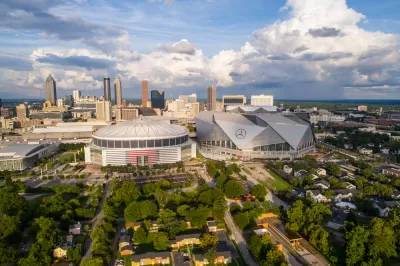
Sean Keenan writes that Atlanta’s Northside Drive pedestrian bridge was a fiscal boondoggle that highlights income inequality in the city. The bridge, which connects the Vine City neighborhood to the Mercedes-Benz Stadium, cost about $33 million to construct—$10 million more than initial cost estimates. And the bridge was supposed to be ready for the Super Bowl earlier this year, but it was not open to the public.
Keenan compares the pedestrian bridge to the 5th Street bridge in the Midtown area, which cost just over $10 million in 2004. "The 5th Street bridge repurposed an otherwise 'mediocre swath of concrete spanning the city’s vast Connector' into a complete streets success, replete with green space, seating, bike lanes, and wide sidewalks."
Keenan points out that building a costly pedestrian bridge to the stadium reflects the larger issue of the use of public funds in Atlanta. "Especially this summer, Atlanta has been criticized for prioritizing and subsidizing projects that make life more comfortable for motorists, sometimes at the expense of non-drivers," says Keenan.
FULL STORY: Report: Downtown pedestrian bridge shows city not built to foster equality

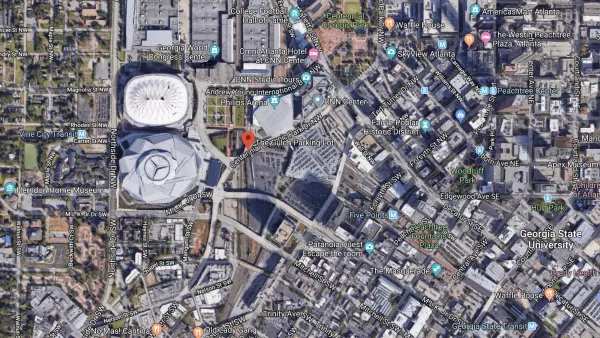
$1.9 Billion Public Financing Plan for Atlanta Mega-Project Headed to Appeal
The sage over The Gulch development project—soon to be renamed Centennial Yards—will continue after project opponents filed an appeal of a June court decision upholding public financing for the project.
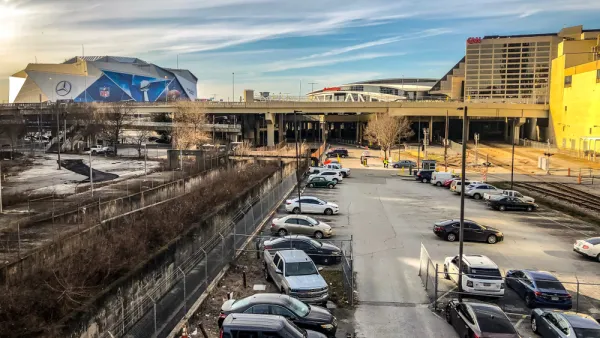
Court Ruling Clears $1.9 Billion in Public Money for Atlanta Mega-Project
A $5 billion redevelopment project in Atlanta, named Centennial Yards, will receive substantial public support.

Sunday Fun: The Super Bowl in Atlanta on Social Media
Traffic and cars play a central role in the social media chatter surrounding the Super Bowl in Atlanta.

Planetizen Federal Action Tracker
A weekly monitor of how Trump’s orders and actions are impacting planners and planning in America.

The state-sanctioned urbicide of Austin
People don’t kill cities. Freeways do.

US to reduce Colorado River water deliveries to Mexico
A new Colorado Treaty amendment reduces Mexico’s Colorado River water allocation by 250,000 acre feet.

Mamdani overhauls NYC's Vision Zero plan with 100 new policy goals
The overhaul aims to reduce traffic deaths and make streets safer for pedestrians, cyclists and drivers through lower speed limits, new safety infrastructure and more.

Amtrak not solely to blame for New Jersey commuter rail's unreliability, report finds
A new study from the Garden State Initiative found that NJ Transit’s budget grew 20% across a 4 year period, but reliability declined significantly over the same period.

EPA erases limits on planet-warming pollution from power plants
Under Monday’s plan, power plants would still have some limits on how much mercury, arsenic and other contaminants they can emit.

FREE Course: Walkable City 1: Why Walkability?
After describing his path towards focusing on walkability as the essence of good planning, Jeff Speck marches through his five principal reasons for making more walkable places.
Reinventing Malls: Planning Alchemy—Turning Gray Fields Into Gold
The course focuses on the opportunities and imperatives that shape reinvention of mall sites.

Eagle County Government
Harvard University Graduate School of Design
Nashville Planning Department
The Architects Foundation
University of Cincinnati Online
The Pocatello Development Authority
The Urban Renewal Agency of the City of Pocatello
Journal of the American Planning Association