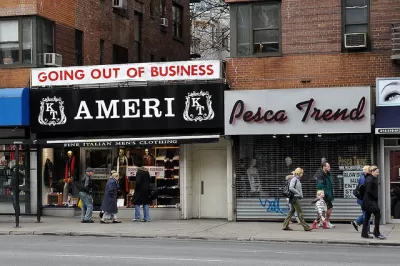
A new report from the New York Department of City Planning has found that storefront vacancy may not be a one-answer citywide problem. Vacancies were found to be concentrated in certain neighborhoods, and the reasons appear to be varied.


Michelle Cohen reports:
Amid discussions of gentrification and astronomical rents, it’s impossible not to notice the alarming appearance of vacant storefronts in what seems like every neighborhood in New York City. A new report from the Department of City Planning (DCP) has attempted to get a closer look at the data behind this phenomenon to get a better understanding of how the city’s retail and storefront uses may be changing. The report, titled “Assessing Storefront Vacancy in NYC,” looks at 24 neighborhoods as case studies. The very detailed study found that, overall, storefront vacancy may not be a one-answer citywide problem. Vacancies were found to be concentrated in certain neighborhoods, and the reasons appear to be as many and varied as the neighborhoods themselves.
Cohen also lists a few of the study's key findings:
- The retail industry is changing rapidly across New York City and the country.
- Vacancy rates are volatile, vary from neighborhood to neighborhood and street to street, and cannot be explained by any single factor.
- Vacancy is concentrated only in certain neighborhoods and is influenced by local and citywide market forces and spending patterns.
The "Assessing Storefront Vacancy in NYC: 24 Neighborhood Case Studies" [pdf] report is available online.
FULL STORY: New study finds reasons for storefront vacancy are as varied as NYC neighborhoods themselves

NYC needs 700,000 new homes to resolve housing crisis, report states
The report gave every neighborhood a non-binding development target.
Beacon / Bunker
Kris Graves photographs all 77 NYPD precincts from Tottenville to Edenwald, looking to these buildings—sometimes humble, sometimes imposing—for the face and footprint of law and order in the neighborhood.
Manhattan Traffic Spreading to Other Boroughs
New travel patterns and an increased reliance on delivery services and ride-hailing are creating more congestion in New York's outer boroughs.

Planetizen Federal Action Tracker
A weekly monitor of how Trump’s orders and actions are impacting planners and planning in America.

The state-sanctioned urbicide of Austin
People don’t kill cities. Freeways do.

US to reduce Colorado River water deliveries to Mexico
A new Colorado Treaty amendment reduces Mexico’s Colorado River water allocation by 250,000 acre feet.

Mamdani overhauls NYC's Vision Zero plan with 100 new policy goals
The overhaul aims to reduce traffic deaths and make streets safer for pedestrians, cyclists and drivers through lower speed limits, new safety infrastructure and more.

Amtrak not solely to blame for New Jersey commuter rail's unreliability, report finds
A new study from the Garden State Initiative found that NJ Transit’s budget grew 20% across a 4 year period, but reliability declined significantly over the same period.

EPA erases limits on planet-warming pollution from power plants
Under Monday’s plan, power plants would still have some limits on how much mercury, arsenic and other contaminants they can emit.

FREE Course: Walkable City 1: Why Walkability?
After describing his path towards focusing on walkability as the essence of good planning, Jeff Speck marches through his five principal reasons for making more walkable places.
Reinventing Malls: Planning Alchemy—Turning Gray Fields Into Gold
The course focuses on the opportunities and imperatives that shape reinvention of mall sites.

Eagle County Government
Harvard University Graduate School of Design
Nashville Planning Department
The Architects Foundation
University of Cincinnati Online
The Pocatello Development Authority
The Urban Renewal Agency of the City of Pocatello
Journal of the American Planning Association