Kris Graves photographs all 77 NYPD precincts from Tottenville to Edenwald, looking to these buildings—sometimes humble, sometimes imposing—for the face and footprint of law and order in the neighborhood.


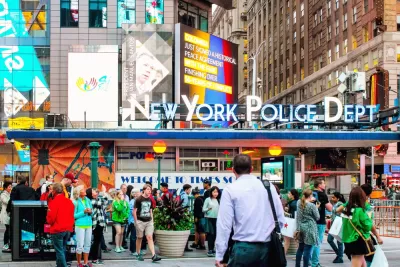
What’s the difference between a school, a library, and a police precinct? They’re all civic institutions designed to communicate their contribution to a well-functioning society. And the buildings are similar in appearance. The products of several waves of municipal construction, their locations track a growing urban population on an expanding metropolitan footprint, from dense center to leafy edges. The primary distinction might be the sea of cars parked in front of and around the police precinct, often on the sidewalk, perpendicular to the curb. The cars are the clearest sign of the exceptional powers of the building’s inhabitants, who can defy the parking dictates everyone else must live by. Beyond parking privileges, they alone can arrest people, detain them, surveil them, physically constrain them, or shoot them. For all the comparisons of schools to jails, or the myth of the oppressive silence of the library, the power of the police is unique in the city.
Read the full story: Beacon / Bunker

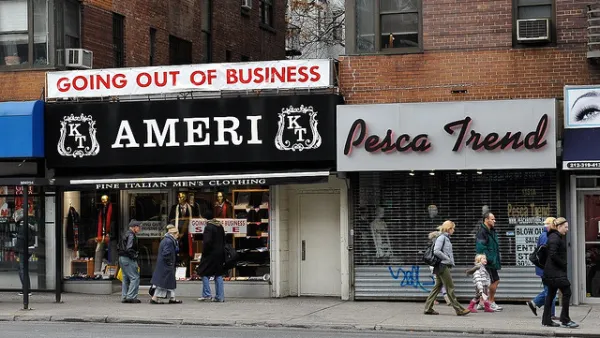
Planning Department Study Documents Storefront Vacancy in NYC Neighborhoods
A new report from the New York Department of City Planning has found that storefront vacancy may not be a one-answer citywide problem. Vacancies were found to be concentrated in certain neighborhoods, and the reasons appear to be varied.
NYC needs 700,000 new homes to resolve housing crisis, report states
The report gave every neighborhood a non-binding development target.
Manhattan Traffic Spreading to Other Boroughs
New travel patterns and an increased reliance on delivery services and ride-hailing are creating more congestion in New York's outer boroughs.

Planetizen Federal Action Tracker
A weekly monitor of how Trump’s orders and actions are impacting planners and planning in America.

Amtrak, CN end decades-long dispute with eight-year agreement
The new operating agreement establishes an updated framework for the companies to work together, including processes to resolve disputes.

Judges permit Denver to divert 77,000 acre feet from the Colorado River for reservoir expansion
Overuse and climate change have caused the Colorado River’s water levels to plummet.

NYC DOT wants faster, more permanent street upgrades
The city is examining ways to build more concrete infrastructure without getting entangled in 'decades-long' projects.

'Something we’ve never seen before:' rising utility rates could strain city finances nationwide
Data centers, climate change and other factors have caused utility rates in the United States to increase by 38% since 2020.

Trump to overrule local leaders, lease millions of acres of America’s Pacific Island territories’ seafloors to mining companies
International law says that the Indigenous people of America’s territories have a right to prior and informed consent regarding projects that impact their countries.

FREE Course: Walkable City 1: Why Walkability?
After describing his path towards focusing on walkability as the essence of good planning, Jeff Speck marches through his five principal reasons for making more walkable places.
Reinventing Malls: Planning Alchemy—Turning Gray Fields Into Gold
The course focuses on the opportunities and imperatives that shape reinvention of mall sites.

Harvard University Graduate School of Design
KFH Group Inc.
Greater Baltimore Committee
The Architects Foundation
University of Cincinnati Online
The Pocatello Development Authority
The Urban Renewal Agency of the City of Pocatello