Startups are increasingly abandoning the suburban office park to try their luck in denser urban cores. According to this study, good transit is one factor behind that trend. But it's not the only one.


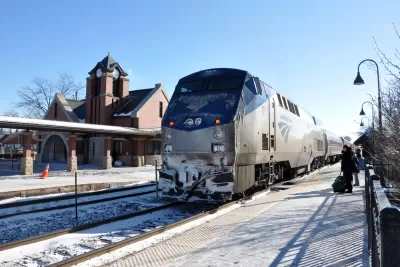
"High-tech startups have become increasingly urban in the past decade or so, gravitating to dense neighborhoods in downtown San Francisco and Lower Manhattan, which have supplanted Silicon Valley as the nation's leading centers for such startups," Richard Florida writes. Among new businesses of all types, access to transit is playing a part in that shift.
Florida discusses a study that uses spatial econometric techniques to analyze the relationship between transit and startups in five cities: San Jose, Austin, Philadelphia, Cleveland, and Boston. "The study documents a close relationship between startups and transit, even though the average block in the study has residents with a fairly high level of car ownership," Florida writes. The study finds a greater association between commuter trains and new startups, at about double the rate of light and heavy rail.
At the same time, the study demonstrates that transit is only one way for burgeoning urban cores to attract new businesses. After all, both San Jose and Austin are renowned for their startup culture and neither has particularly well-developed transit infrastructure. Boston is an example of a city that boasts both.
Read the full story: Startups Are Abandoning Suburbs for Cities With Good Transit
Learning loss and urban schools, part 2
Did test scores in progressive cities drop more post-COVID than test scores in moderate ones?

10 U.S. Cities Launch Anti-Displacement Network
More than half of American tenants are rent-burdened, putting them at risk of displacement. A national collaboration with PolicyLink hopes to help.
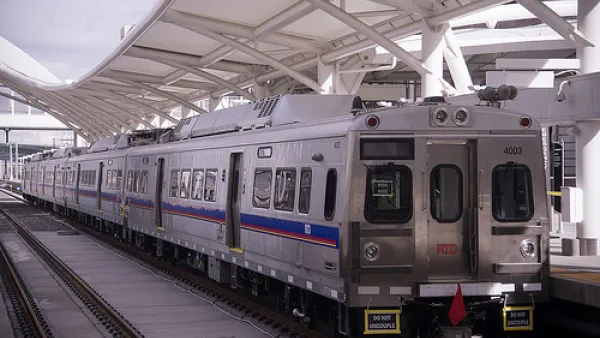
Denver's Commuter Rail Cars: Same as SEPTA's But Without the Defects
Denver's transit agency is running very similar Hyundai Rotem EMUs on their new A Line to the airport. The car shells are imported from South Korea and assembled in the same Philadelphia plant as SEPTA's problem-plagued Silverliner V cars.

Planetizen Federal Action Tracker
A weekly monitor of how Trump’s orders and actions are impacting planners and planning in America.

California plans to bury El Niño’s downpour
If the state plays its cards right, it may be able to store a billion acre-feet of El Niño’s water in aquifers.

Desperate measures: Advocates weigh draining Lake Powell to fill Colorado River
Draining the reservoir could reduce evaporation losses by a couple hundred thousand acre-feet.

Housing is the top priority of Seattle’s sole new councilmember
Jenks campaigned on building 1,000 new units of affordable housing.

New tax cuts may slash $1.5 billion in funding for Miami transit, public parks
Amendment 3 will save Miami-Dade homeowners $2,700 in 2028.

Arizona, Wisconsin, Pennsylvania hope to finally advance climate goals post-midterms
The three states have spent years under Republican or divided control.

FREE Course: Walkable City 1: Why Walkability?
After describing his path towards focusing on walkability as the essence of good planning, Jeff Speck marches through his five principal reasons for making more walkable places.
Reinventing Malls: Planning Alchemy—Turning Gray Fields Into Gold
The course focuses on the opportunities and imperatives that shape reinvention of mall sites.

City of Rosemead
Rutgers University, Edward J. Bloustein School of Planning and Public Policy
One Hundred Miles
University of Michigan School for Environment and Sustainability (SEAS)
Hunter College, City University of New York (CUNY)
The Architects Foundation
City of Cambridge
Montrose County
The Pocatello Development Authority