The Minister for Transport called it "part of the answer to climate change" – charging air travelers a modest fee for international trips that originate in France and investing the revenue in greener alternatives such as rail transport.


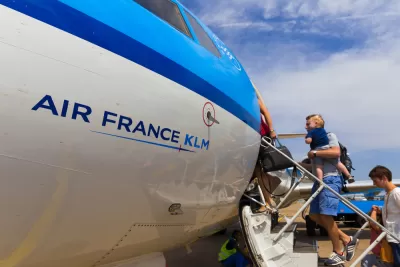
"Transport Minister Élisabeth Borne said a news conference [on July 9] that an “ecotax” on flights departing from France would be introduced next year," reports Adam Taylor for The Washington Post.
It would amount to between 1.50 euros ($1.70) and 18 euros ($20) per flight, Borne said, and is expected to raise more than 180 million euros. That money would then be reinvested in eco-friendly transport, such as rail networks.
Borne said this reallocation of funds could be “part of the answer to the climate challenge.”
Visitors to France would not pay the tax on their inbound flights, but would pay it when they leave, as would French residents, effective January 1, 2020, although it would not apply to connecting flights.
Not just climate but equity
The comparison to the yellow vest insurrection, a populist revolt that began last November in response to a planned carbon tax that would have been added to petrol and diesel fuels in January 2019, is difficult to avoid. The fuel tax increases inspired the largest and most violent mass demonstrations in France since 1968.
Though sparked by a carbon tax, the movement by working-class residents, largely from outside the country's largest cities, was more a revolt against social inequities than efforts to fight climate change. By contrast, the aviation ecotax will target a much higher-earning demographic, but it would be aimed at behavior, not income, unlike the Green New Deal legislation in the U.S., a point highlighted below by Dutch State Secretary for Finance Menno Snel of The Netherlands.
European-wide aviation tax?
Taylor noted that Britain and Sweden implemented aviation taxes, in part to address climate change, last year, which has prompted consideration of a multi-country tax.
The Dutch government is lobbying the European Union to introduce a continent-wide tax on aviation that would prevent airlines from changing their routes to avoid taxes.
“People also feel that in the end, we have to collect taxes,” Snel said in an interview with The Washington Post earlier this year. “If you can choose between taxing the income of people or pollution and CO2, it makes more sense to try and find a tax base on the second than on the first."
Air travel's growing carbon footprint
In its March report, the Paris-based International Energy Agency warned that growing air travel was one of the reasons for increasing global energy consumption and carbon emissions.
Air traffic volumes have increased significantly in recent years, particularly in China and India. Jet fuel has become a major contributor to higher oil consumption. Last year, it accounted for 20% of total global oil demand growth.
In the U.S., transportation emissions increased last year largely due to an increase from the trucking and aviation sectors, while emissions from light-duty motor vehicles decreased slightly, according to the Rhodium Group.
The 2015 Paris climate accord does not cover air travel. The following year, almost 200 countries signed the market-based Carbon Offsetting and Reduction Scheme for International Aviation (CORSIA), administered by the International Civil Aviation Organization, a United Nations specialized agency. However, that agreement does not include passenger fees like the French program.
Industry opposition
"Soon after the French government unveiled the plan, Air France announced that it 'strongly disapproves' of the tax, issuing a statement in which it said the initiative would cost its combined airlines more than $67 million each year," reports Bill Chappell for NPR. "The airline is partly owned by the French government."
They are not alone. The industry position, articulated by the industry trade group, the International Air Transport Association in a May 2019 Fact sheet: taxes & the environment [pdf], is that "Governments need to support multilateral efforts to address aviation’s emissions, including [the aforementioned] CORSIA, [r]ather than taxing passengers and airlines.
What about support?
Euronews reports on July 10 that "activists said the new tax was unlikely to change consumer behaviour at the proposed levels and was low compared with other countries."
"The government is finally targeting tax breaks for the most polluting industries such as trucking and airlines, but these modest measures will not significantly reduce greenhouse gas emissions," said Climate Action Network's Lorelei Limousin.
Related in Planetizen:
-
JetBlue to Reduce Carbon Footprint with Large Purchase of Renewable Jet Fuel, September 23, 2016
Hat tip to InsideClimate News.
FULL STORY: France moves to combat climate change by making flights more expensive

For Coronavirus Aid, Air France Must Stop Competing With Rail
France is proposing a momentous step toward clean transportation.
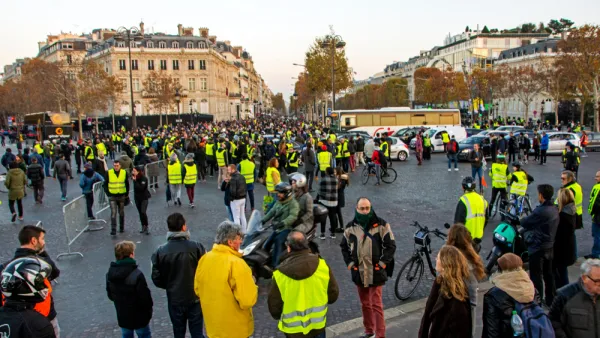
France Drops Road Tolling Plans Amid Fuel Tax Protests
Controversial London-style congestion pricing won't be coming to French cities due to concerns sparked by the 'Yellow Vest' protests over an upcoming fuel tax hike, but President Macron stated the fuel tax increases will go forward in January.
Delta Announces Wheelchair-Friendly Seating
The airline will soon allow passengers using wheelchairs to remain in their own equipment during flights.

Planetizen Federal Action Tracker
A weekly monitor of how Trump’s orders and actions are impacting planners and planning in America.

The state-sanctioned urbicide of Austin
People don’t kill cities. Freeways do.

US to reduce Colorado River water deliveries to Mexico
A new Colorado Treaty amendment reduces Mexico’s Colorado River water allocation by 250,000 acre feet.

5 New England states march closer to 800 megawatt wind energy project
Securing federal approval for the project may be complicated under the Trump administration, which has historically been hostile towards domestic wind power.

Baltimore to break ground on $50 million Transit Priority Project
The project will bring faster bus trips, safer streets and better bike connections to Baltimore.

Airbnb launches $250 million 'last-dollar financing' housing accelerator, makes first investment in Austin
The company will put $6.4 million towards affordable housing development in Texas’ capital.

FREE Course: Walkable City 1: Why Walkability?
After describing his path towards focusing on walkability as the essence of good planning, Jeff Speck marches through his five principal reasons for making more walkable places.
Reinventing Malls: Planning Alchemy—Turning Gray Fields Into Gold
The course focuses on the opportunities and imperatives that shape reinvention of mall sites.

Eagle County Government
Harvard University Graduate School of Design
Nashville Planning Department
The Architects Foundation
University of Cincinnati Online
The Pocatello Development Authority
The Urban Renewal Agency of the City of Pocatello
Journal of the American Planning Association