Noise and drug dealers are two reasons to remove city-owned basketball hoops every day. Or you could give the public resources for fun and exercise in place, which is what Toronto decided to do this week.



"It took one viral video — boys throwing a basketball at an empty backboard in broad daylight — to halt a long-standing city practice," reports Jennifer Pagliaro.
The city spent about a decade removing rims from city-owned basketball courts until the video woke the public up to the punitive and counter-productive nature of the practice.
The practice began in 2008 as a response to noise complaints from residents living near city basketball courts. City spokesperson Brad Ross said in a statement that noise complaints will be addressed on a case-by-case basis in the future.
“Having a big city is a balancing act all the time,” Mayor John Tory told reporters Thursday morning. “I think that what happened, as often happens in cases like this, is that balance was lost, in that I can understand 10 o’clock at night people maybe — or 11 o’clock at night — saying that they’re concerned about noise. But at 6 o’clock in the evening or even 9 o’clock in the evening at this time of year we should be doing everything we can to get as man kids as possible to be playing basketball in our public parks.”
Tory said residents can’t assume they will live free of noise in a city like Toronto and said there is a need to have “healthy, positive” activities for youth.
Focusing on noise might only tell part of the story, however. Pagliaro also notes that rims were originally removed as a deterrent against "drug dealers."
Read the full story: After viral video, city halts long-standing practice of taking basketball rims down at some public courts
Underpass Finds New Life As Park
The land underneath a Toronto highway overpass will be converted into a neighborhood park. Officials hope it will spark the revival of one of the city's underused waterfront neighborhoods.
Toronto Mulls Corporate Sponsorship for Parks
Short on funding, Toronto's waterfront parks agency is considering a plan to sell the naming rights to the park's amenities, allowing corporate sponsors to add their name to such public features as walkways and play areas.
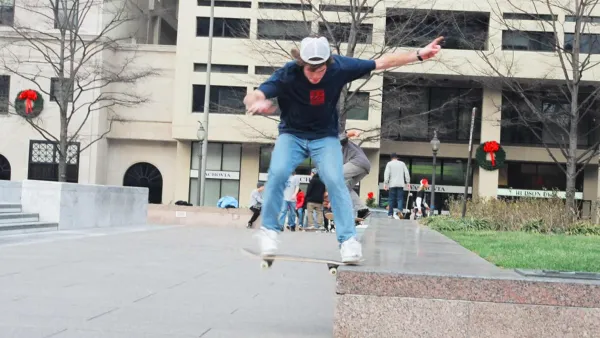
Trump's DC 'beautification' efforts threaten historic skate spots
The city is taking more aggressive measures to prevent skateboarders from using unsanctioned public spaces.

Planetizen Federal Action Tracker
A weekly monitor of how Trump’s orders and actions are impacting planners and planning in America.

California plans to bury El Niño’s downpour
If the state plays its cards right, it may be able to store a billion acre-feet of El Niño’s water in aquifers.

Desperate measures: Advocates weigh draining Lake Powell to fill Colorado River
Draining the reservoir could reduce evaporation losses by a couple hundred thousand acre-feet.

Mamdani’s pied-à-terre tax survives legal challenge
A panel of judges found that the plaintiffs failed to demonstrate injury as a result of New York City's implementation of the tax.

Eastern Nebraska is running out of electricity
Data centers and electrification are straining eastern Nebraska’s grid, throttling economic development.

Seattle passes record-breaking transit services expansion
Proposition 1 will double the city’s transit tax to add 95,000 more bus trips and preserve 180,000 bus trips annually.

FREE Course: Walkable City 1: Why Walkability?
After describing his path towards focusing on walkability as the essence of good planning, Jeff Speck marches through his five principal reasons for making more walkable places.
Reinventing Malls: Planning Alchemy—Turning Gray Fields Into Gold
The course focuses on the opportunities and imperatives that shape reinvention of mall sites.

City of Rosemead
Rutgers University, Edward J. Bloustein School of Planning and Public Policy
One Hundred Miles
University of Michigan School for Environment and Sustainability (SEAS)
Hunter College, City University of New York (CUNY)
The Architects Foundation
City of Cambridge
Montrose County
The Pocatello Development Authority