A question of whose business is suppressing whose in the city of Chicago was decided by the State Supreme Court.


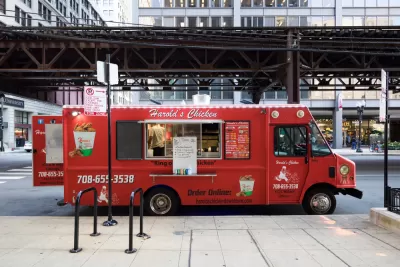
"The Illinois Supreme Court ruled Thursday that Chicago’s food truck regulations are constitutional and that the city can protect restaurants from their wheeled competitors," reports Alexia Elejalde-Ruiz.
"The court affirmed the ruling of the appellate court and the circuit court in a lawsuit that claimed Chicago’s food truck restrictions suppress competition," according to Elejalde-Ruiz.
The owner of a food truck called Cupcakes for Courage brought the original lawsuit against a rule in Chicago that prohibited "food trucks from parking within 200 feet of any establishment that serves food — a category that includes convenience stores with hot dog rollers," explains Elejalde-Ruiz. The lawsuit challenged other aspects of the law, including a requirement that food trucks carry a GPS unit for tracking by the city.
The State Supreme Court uphold the law by noting the city's interest in the long-term stability of brick and mortar restaurant businesses.
FULL STORY: Chicago's food truck restrictions can stand, Illinois Supreme Court rules


Obama Presidential Center Dealt Legal Setback
There are more than a few reasons to think that the Obama Presidential Center won't go the way of the Lucas Museum of Narrative Art, which gave up and decamped for Los Angeles.

Judge Sets Back NYC's Attempt to Grab Airbnb's Data
A 2018 law required Airbnb to share the names and addresses of hosts in the New York City. A judge ruled that the mandate violates the 4th Amendment.
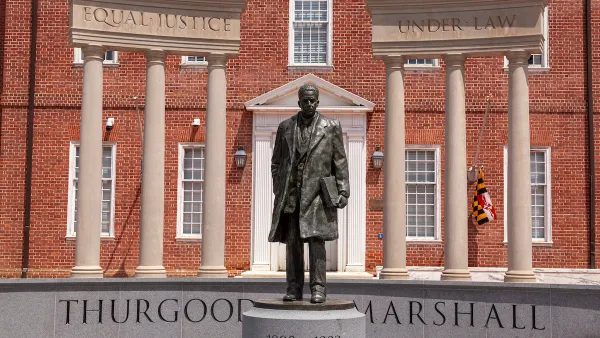
State Supreme Court Clears Way for Defunct Airport Redevelopment in Maryland
The legal controversies over a zoning amendment approved in 2019 went all the way to the top court in the state of Maryland, but by the time the court ruled, the Bowie City Council had already repealed the amendment in question.

The state-sanctioned urbicide of Austin
People don’t kill cities. Freeways do.

US to reduce Colorado River water deliveries to Mexico
A new Colorado Treaty amendment reduces Mexico’s Colorado River water allocation by 250,000 acre feet.

New Jersey’s second-largest city bans standalone data centers
Jersey City will continue to allow co-location facilities, such as those meant for research institutions that store their own data.

Amtrak not solely to blame for New Jersey commuter rail's unreliability, report finds
A new study from the Garden State Initiative found that NJ Transit’s budget grew 20% across a 4 year period, but reliability declined significantly over the same period.

EPA erases limits on planet-warming pollution from power plants
Under Monday’s plan, power plants would still have some limits on how much mercury, arsenic and other contaminants they can emit.

Phoenix announces new on-demand transit service, more frequent RAPID buses
Both new services will launch in October, and are part of Phoenix's Project Effective Access Solutions for Easing Congestion.

FREE Course: Walkable City 1: Why Walkability?
After describing his path towards focusing on walkability as the essence of good planning, Jeff Speck marches through his five principal reasons for making more walkable places.
Reinventing Malls: Planning Alchemy—Turning Gray Fields Into Gold
The course focuses on the opportunities and imperatives that shape reinvention of mall sites.

Eagle County Government
Harvard University Graduate School of Design
Nashville Planning Department
The Architects Foundation
University of Cincinnati Online
The Pocatello Development Authority
The Urban Renewal Agency of the City of Pocatello
Journal of the American Planning Association