In the face of displacement and gentrification, residents of the Fruit Belt neighborhood of Buffalo, NY point to tech-giant Google's map service as one among many possible causes.


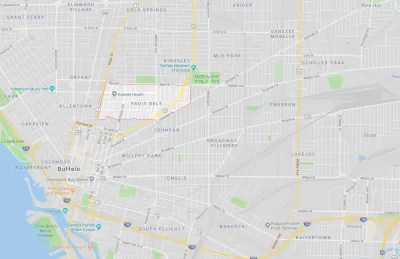
In the late 2000s, public outcry over the development of the Buffalo Niagara Medical Campus in the Fruit Belt neighborhood of Buffalo, NY brought shed light on a complex community identity conflict. Residents saw their drastically changing neighborhood undergo rapid transformation and gentrification. In addition to this displacement, they observed that the name of their neighborhood, the "Fruit Belt," was erased from Google Maps and replaced with the name "Medical Park."
In the historically Black and German immigrant neighborhood, "community members argued the designation was a calculated tweak in favor of gentrification, a digital rechristening," writes Caitlin Dewey. "The misnomer also revealed a great deal about the invisible process major tech firms use to put neighborhoods on their maps—and how decisions based off arcane data sets can affect communities thousands of miles away."
Digital erasure is not the only way the ownership of the Fruit Belt was forcibly removed from long-time residents, notes Dewey:
[D]evelopers tore down low-income townhouses and bought out a nearby African-American cultural center to make way for new apartments and medical offices. Worse, some residents reported rent hikes of as much as 50 percent, and one in three homes sat vacant and unused — a common sign that owners planned to resell them at a higher price.
As a result of Dewey's journalistic research, Good Maps corrected the name of the Fruit Belt. This acknowledgement of collective community autonomy is only a small step in the right direction.
FULL STORY: How Google's Bad Data Wiped a Neighborhood off the Map


10 U.S. Cities Launch Anti-Displacement Network
More than half of American tenants are rent-burdened, putting them at risk of displacement. A national collaboration with PolicyLink hopes to help.
Is this the first wave of de-gentrification?
Valencia, Temescal, H Street and the fickle fortunes of the gentrified neighborhood.
Detroit greenway brings revival — and fears of displacement
The planned Joe Louis Greenway is already bringing change to the neighborhoods near it.

Planetizen Federal Action Tracker
A weekly monitor of how Trump’s orders and actions are impacting planners and planning in America.

The state-sanctioned urbicide of Austin
People don’t kill cities. Freeways do.

US to reduce Colorado River water deliveries to Mexico
A new Colorado Treaty amendment reduces Mexico’s Colorado River water allocation by 250,000 acre feet.

5 New England states march closer to 800 megawatt wind energy project
Securing federal approval for the project may be complicated under the Trump administration, which has historically been hostile towards domestic wind power.

Baltimore to break ground on $50 million Transit Priority Project
The project will bring faster bus trips, safer streets and better bike connections to Baltimore.

Airbnb launches $250 million 'last-dollar financing' housing accelerator, makes first investment in Austin
The company will put $6.4 million towards affordable housing development in Texas’ capital.

FREE Course: Walkable City 1: Why Walkability?
After describing his path towards focusing on walkability as the essence of good planning, Jeff Speck marches through his five principal reasons for making more walkable places.
Reinventing Malls: Planning Alchemy—Turning Gray Fields Into Gold
The course focuses on the opportunities and imperatives that shape reinvention of mall sites.

Eagle County Government
Harvard University Graduate School of Design
Nashville Planning Department
The Architects Foundation
University of Cincinnati Online
The Pocatello Development Authority
The Urban Renewal Agency of the City of Pocatello
Journal of the American Planning Association