The Colorado River Drought Contingency Plan will head to President Trump's desk for an expected signature before heading back to seven states for final ratification.


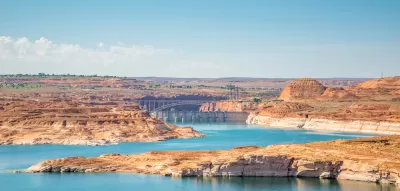
"Two weeks after water officials told Congress there was urgent need to approve the Colorado River drought contingency plan, the House and Senate both passed a plan Monday and sent it to the president’s desk," reports Andrew Howard.
Congressional approval brings the Drought Contingency Plan (DCP) one critical step closer to final approval, in a "culmination of years of negotiations between the seven states in the Colorado River Basin on how much each state can draw from the river if Lake Powell and Lake Mead drop to crisis levels."
As approved by both houses of Congress, the Colorado River Drought Contingency Plan Authorization Act "[requires] that the Interior secretary authorize the water allocation agreement [pdf] hammered out by Arizona and the six other basin states. That deal is designed to prevent a potential water crisis and settle disputes over who gives up water if the river reaches a crisis level," according to Howard.
Included in that allocation agreement, for instance, is mandatory rationing for Arizona in the event that water levels in Lake Mead fall below a certain point.
As noted by recent Planetizen coverage, the DCP contains serious implications for the Salton Sea in California and the city of Las Vegas as well, in addition to the broader implications for Wyoming, Utah, Colorado, Arizona, New Mexico, Nevada, California, and Mexico.
FULL STORY: House, Senate OK Colorado River drought plan, capping years of debate

New Drought Contingencies Triggered for Upper Colorado River States
The latest Bureau of Reclamation report on water levels in Lake Powell and Lake Mead trigger new drought contingencies in Colorado, New Mexico, Utah, and Wyoming.
More Need Than Ever for Drought Resilience on the Colorado River
The effects of climate change are already cutting deeply into the lifeblood of the U.S. West—the Colorado River.
Drought Takes Hold of the American West
The megadrought continues, with contingency plans differing by location.

The state-sanctioned urbicide of Austin
People don’t kill cities. Freeways do.

US to reduce Colorado River water deliveries to Mexico
A new Colorado Treaty amendment reduces Mexico’s Colorado River water allocation by 250,000 acre feet.

New Jersey’s second-largest city bans standalone data centers
Jersey City will continue to allow co-location facilities, such as those meant for research institutions that store their own data.

Amtrak not solely to blame for New Jersey commuter rail's unreliability, report finds
A new study from the Garden State Initiative found that NJ Transit’s budget grew 20% across a 4 year period, but reliability declined significantly over the same period.

EPA erases limits on planet-warming pollution from power plants
Under Monday’s plan, power plants would still have some limits on how much mercury, arsenic and other contaminants they can emit.

Phoenix announces new on-demand transit service, more frequent RAPID buses
Both new services will launch in October, and are part of Phoenix's Project Effective Access Solutions for Easing Congestion.

FREE Course: Walkable City 1: Why Walkability?
After describing his path towards focusing on walkability as the essence of good planning, Jeff Speck marches through his five principal reasons for making more walkable places.
Reinventing Malls: Planning Alchemy—Turning Gray Fields Into Gold
The course focuses on the opportunities and imperatives that shape reinvention of mall sites.

Eagle County Government
Harvard University Graduate School of Design
Nashville Planning Department
The Architects Foundation
University of Cincinnati Online
The Pocatello Development Authority
The Urban Renewal Agency of the City of Pocatello
Journal of the American Planning Association