Now that the plans to extend the 710 Freeway in Southern California between Alhambra and Pasadena are finally dead, the question remains about what to do with the state-owned land at either end of the planned route.


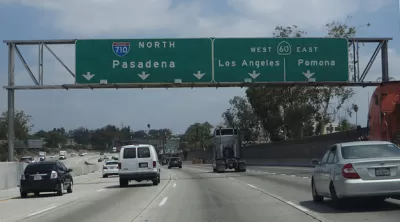
"With state legislation proposed that could remove the 710 Freeway extension from future consideration, Alhambra and Pasadena are making preparations for what could happen to the almost-100 acres of land comprising the loose freeway ends," reports Christopher Yee.
There is state legislation for putting the final nails in the coffin of the 710 extension plan, which has already been ended by the planning agencies potentially responsible, but none of that legislation "addresses what would become of the freeway stubs, one at the terminus of the 710 that spills onto Valley Boulevard in Alhambra and the 50-acre concrete ditch running through west Pasadena that was once part of the proposed extension," according to Yee.
The cities of Alhambra and Pasadena both recently met to discuss the subject, and they both have their own concerns. Pasadena is worried about the state selling the land to the highest bidder with no feedback or veto power offered to the city. Alhambra, meanwhile, wants to build a park where the free would have gone.
"Most Alhambra residents who spoke at Monday’s meeting were not in favor of the park idea and instead asked the city to advocate against the closure of the 710 stub, arguing that any such closure would create an even worse traffic situation than the existing one, with cars filling Valley Boulevard while waiting to turn north onto Fremont Avenue toward South Pasadena and Pasadena," according to Yee.
Read the full story: Pasadena, Alhambra move forward on obtaining twin 710 Freeway stubs from Caltrans

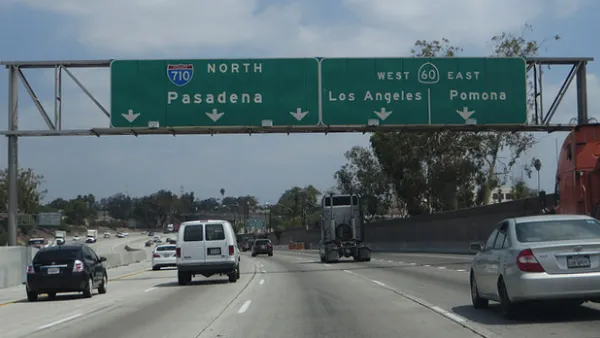
After a Failed Freeway Plan, Alternatives Prove Controversial
With plans to extend California's 710 Freeway off the table, cities in the path have been awarded funds for alternative road projects. But residents of San Marino aren't all on board.
With a 710 Freeway Extension Unlikely, Cities Propose Alternatives
After withdrawing support for a controversial extension of the 710 Freeway, Los Angeles Metro is asking cities for local road improvements to improve traffic flow in its stead.
Public Opinion Split on I-710 Tunnel Plans in Southern California
The public comment period has ended on one of Southern California's most persistent planning controversies—a proposal to connect the I-710 Freeway between Pasadena and Alhambra. The current plan calls for a long underground tunnel.

Amtrak, CN end decades-long dispute with eight-year agreement
The new operating agreement establishes an updated framework for the companies to work together, including processes to resolve disputes.

Judges permit Denver to divert 77,000 acre feet from the Colorado River for reservoir expansion
Overuse and climate change have caused the Colorado River’s water levels to plummet.
Nation's most wind-powered state turns to coal as data centers increase energy demand
For the first time in decades, Iowa has increased its generation of coal power.

Boston has spent millions making the Green Line more accessible — and there’s no end in sight
While the city has invested millions into expanding and adding platforms to the Green Line to make it more accessible, new train cars set to arrive next year will be too tall for disabled passengers to board without raising the current platforms.

Idaho may see an 18% drop in federal surface transit funding — the largest estimated cut in the US
Transit systems in rural communities are much more reliant on federal funding to provide their services.

How ‘post-disaster gentrification’ alters neighborhoods after natural calamities
After hurricanes, fires or other calamities, the original residents of a community are often replaced by younger, wealthier residents.

FREE Course: Walkable City 1: Why Walkability?
After describing his path towards focusing on walkability as the essence of good planning, Jeff Speck marches through his five principal reasons for making more walkable places.
Reinventing Malls: Planning Alchemy—Turning Gray Fields Into Gold
The course focuses on the opportunities and imperatives that shape reinvention of mall sites.

City of Wisconsin Rapids
Harvard University Graduate School of Design
KFH Group Inc.
The Architects Foundation
University of Cincinnati Online
The Pocatello Development Authority
The Urban Renewal Agency of the City of Pocatello