With plans to extend California's 710 Freeway off the table, cities in the path have been awarded funds for alternative road projects. But residents of San Marino aren't all on board.


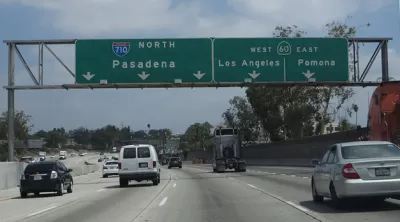
"The city of San Marino is considering returning $32 million in grants earmarked for street improvements and awarded by Metro as alternatives to extending the 710 Freeway after many residents said the city should not be hoodwinked into projects which would bring in outsiders and degrade their quality of life," Steve Scauzillo writes.
Plans to extend Southern California's 710 Freeway to cover a 4.5-mile gap are now dead, following a drawn-out debate. In their place, the Los Angeles County Metropolitan Transportation Authority (Metro) provided $515 million to fund 34 road projects submitted by cities with land in the gap. They include modifications like adding turn lanes and synchronizing traffic signals.
Now, citing concerns over traffic speeds, residents of San Marino may turn down projects proposed by city staff. According to an email from Metro to San Marino Councilman Steven Talt, Scauzillo reports, "the city could start from a clean slate as long as the new projects meet Metro's criteria of reducing congestion and enhancing safety."
At a public meeting to discuss the proposals, Scauzillo continues, some residents revisited "old wounds" from the long debate over whether to extend the 710. "Alhambra and San Marino fought for the freeway extension/tunnel and lost. South Pasadena and later Pasadena and La Cañada Flintridge opposed the freeway extension, even as a tunnel, and won the battle."
See also: Where a Freeway Plan Failed, a Development Opportunity Rises
Read the full story: San Marino residents to Metro: Here’s your $32 million back, we don’t want your road projects
With a 710 Freeway Extension Unlikely, Cities Propose Alternatives
After withdrawing support for a controversial extension of the 710 Freeway, Los Angeles Metro is asking cities for local road improvements to improve traffic flow in its stead.
L.A. Metro Board Removes Support for Controversial 710 Freeway Tunnel Plan
The saga of the 710 Freeway will continue, as it has for decades. Now, however, a proposal to build a 6.3-mile tunnel from El Sereno to Pasadena, has lost key support from the regional transportation agency.
Public Opinion Split on I-710 Tunnel Plans in Southern California
The public comment period has ended on one of Southern California's most persistent planning controversies—a proposal to connect the I-710 Freeway between Pasadena and Alhambra. The current plan calls for a long underground tunnel.

Planetizen Federal Action Tracker
A weekly monitor of how Trump’s orders and actions are impacting planners and planning in America.

Eastern Nebraska is running out of electricity
Data centers and electrification are straining eastern Nebraska’s grid, throttling economic development.

Move over, LA: St. Louis gears up for Olympics, invests millions in downtown redevelopment
The Missouri city will host the 2028 Olympic soccer group stage and knockout matches.

Dallas releases zoning code overhaul to officials
The drafted overhaul is over 400 pages long.

NYC renovations for dangerous, ‘mercilessly crammed’ street delayed until 2027
Construction was supposed to begin this fall.

San Diego’s Midway Rising project gets greenlight from city council
The project looks to become the largest affordable housing development in California's history.

FREE Course: Walkable City 1: Why Walkability?
After describing his path towards focusing on walkability as the essence of good planning, Jeff Speck marches through his five principal reasons for making more walkable places.
Reinventing Malls: Planning Alchemy—Turning Gray Fields Into Gold
The course focuses on the opportunities and imperatives that shape reinvention of mall sites.

City of Rosemead
Rutgers University, Edward J. Bloustein School of Planning and Public Policy
One Hundred Miles
University of Michigan School for Environment and Sustainability (SEAS)
Hunter College, City University of New York (CUNY)
The Architects Foundation
City of Cambridge
The Pocatello Development Authority
The Urban Renewal Agency of the City of Pocatello