Two Bay Area city council members serving on a regional commission suffered the political consequences of supporting a controversial regional housing initiative, not from their constituents, but from their colleagues.



Rachel Swan reports for the San Francisco Chronicle on the second city council member who serves on 21-member Metropolitan Transportation Commission (MTC) to suffer political consequences for voting on Dec. 19 to authorize the commission's approval of the Committee to House the Bay Area (CASA) Compact, a new 15-year regional initiative to address the Bay Area’s housing crisis that includes building 35,000 homes a year throughout the region.
Redwood City Councilwoman Alicia Aguirre lost her spot on the MTC last week. She represented San Mateo County, where mayors of 20 cities regularly meet to select members of boards and commissions. Several mayors told Aguirre that because she backed CASA, “they couldn’t vote for me.”
As posted Jan. 25 after the Bay Area's other major regional planning agency, the Association of Bay Area Governments (ABAG) executive board, voted 21-9 in favor of the CASA Compact, veteran Rohnert Park Councilman Jake Mackenzie, who chairs the MTC and voted to approve the compact, was "stripped by his own City Council Tuesday night [Jan. 22] of influential posts on the Sonoma-Marin Area Rail Transit board and [the Sonoma County Transportation Authority]," reported Kevin Fixler for The Press Democrat.
Earlier this month at a City Council meeting, he faced an hourlong tongue lashing from each of his four fellow council members for backing the CASA Compact...
His fate lies with a selection committee of nine [Sonoma County] mayors who will vote Thursday [Jan 31], and then pass their recommendation along to the Sonoma County Board of Supervisors for a final confirmation next month.
The political consequences suffered by Mackenzie and Aguirre "signal that sharp disagreements remain over how to address the regional housing crisis," writes Swan.
Leaders in some communities feel they are being forced into policies emanating from San Francisco and Oakland, while others see aggressive regional action as imperative.
The CASA Compact [pdf], which pushes a 10-point agenda based on the "three Ps: Production, Preservation, and Protection," "will likely serve as a guide — and as political ammunition — for new state legislation," continues Swan. "Besides setting housing goals, CASA recommends adding taxes, loosening zoning near transit centers and establishing a regional rent cap, among other things."
Hat tip to MTC Transportation Headlines.
FULL STORY: Local leaders find that supporting Bay Area housing plan spurs anger at home


Regional Attempt to Address Housing Crisis Advances in Bay Area
A regional, comprehensive, and controversial approach to tackling the housing affordability crisis in the nine-county Bay Area, including strategies to render renter protections and new housing production, has cleared three major hurdles.

Legislation Introduced to Enable the Bay Area to Tackle Housing Crisis as a Region
A new bill would grant the Housing Alliance for the Bay Area taxing authority to raise revenue in the nine-county region to find solutions to the housing crisis. Another bill would reduce the voter threshold below two-thirds for eligible taxes.
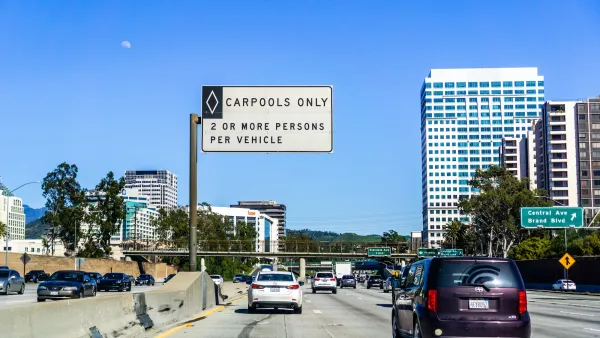
Another Reminder of the Futility of Carpool Lanes
What's the great 'fix' for the flawed Highway 101 carpool lanes in Marin and Sonoma counties in the Bay Area? Reduce the HOV time by two and a half hours during the peak commutes to enable solo drivers greater access to 52 miles of widened freeway.

The state-sanctioned urbicide of Austin
People don’t kill cities. Freeways do.

US to reduce Colorado River water deliveries to Mexico
A new Colorado Treaty amendment reduces Mexico’s Colorado River water allocation by 250,000 acre feet.

New Jersey’s second-largest city bans standalone data centers
Jersey City will continue to allow co-location facilities, such as those meant for research institutions that store their own data.

Amtrak not solely to blame for New Jersey commuter rail's unreliability, report finds
A new study from the Garden State Initiative found that NJ Transit’s budget grew 20% across a 4 year period, but reliability declined significantly over the same period.

EPA erases limits on planet-warming pollution from power plants
Under Monday’s plan, power plants would still have some limits on how much mercury, arsenic and other contaminants they can emit.

Phoenix announces new on-demand transit service, more frequent RAPID buses
Both new services will launch in October, and are part of Phoenix's Project Effective Access Solutions for Easing Congestion.

FREE Course: Walkable City 1: Why Walkability?
After describing his path towards focusing on walkability as the essence of good planning, Jeff Speck marches through his five principal reasons for making more walkable places.
Reinventing Malls: Planning Alchemy—Turning Gray Fields Into Gold
The course focuses on the opportunities and imperatives that shape reinvention of mall sites.

Eagle County Government
Harvard University Graduate School of Design
Nashville Planning Department
The Architects Foundation
University of Cincinnati Online
The Pocatello Development Authority
The Urban Renewal Agency of the City of Pocatello
Journal of the American Planning Association