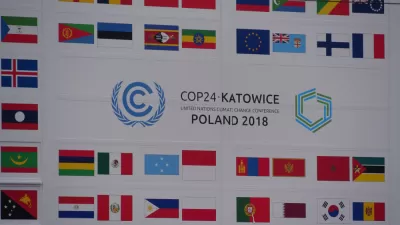
Representatives from nearly 200 nations have been attending the U.N. Climate Change Conference in Katowice since Dec. 2 to work on implementing the 2015 Paris climate agreement. Scheduled to end Friday, it will be extended two days due to discord.


[Update: Brad Plumer, climate reporter for The New York Times, reports on Saturday from Katowice that a deal has been reached that "will ultimately require every country in the world to follow a uniform set of standards for measuring their planet-warming emissions and tracking their climate policies."]
"Critical climate talks have been extended by two days after big polluters including the US and Saudi Arabia pushed back against key scientific findings," reports Josh Gabbatiss, science correspondent for the London-based Independent, on Friday.
Tensions are running high in the Polish city of Katowice following two weeks of fraught discussions at the UN COP24 summit between countries with very different climate agendas.
Experts cautiously welcomed a draft agreement that was finally released on Thursday night, but countries must now resolve outstanding issues, including pledges to ramp up emissions cuts.
WIth Russia and Kuwait, these four leading oil producers blocked the full endorsement of the Intergovernmental Panel on Climate Change’s "Special Report on Global Warming of 1.5°C. "The IPCC was invited to prepare this Special Report by the 21st Session of the Conference of the Parties (COP21) of the United Nations Framework Convention on Climate Change (UNFCCC) in Paris in December 2015," according to a June 2016 UNFCCC press release.
Nations are working in Katowice on the rulemaking needed to implement the 2015 Paris climate agreement effective 2020, including how to report emissions and how richer nations will help finance climate action in poorer nations.
Interesting audio reports with transcripts from NPR on the climate conference:
- On Dec. 14, Rebecca Hersher reports from Katowice on how some American businesses, who have sent representatives to the talks, are committed to reducing their carbon footprint despite President Trump's decision in June 2017 to withdraw from the Paris agreement.
- On Dec. 13, Audie Cornish reports on how the U.S. can advance climate negotiations under President Trump in a very informative discussion with Jonathan Pershing, former Special Envoy for Climate Change under President Obama and now the Program Director of Environment at the William and Flora Hewlett Foundation. Yes, the U.S. did send an official delegation, even if they proved disruptive. Pershing explains the U.S. remains in the agreement "until the day after the next presidential election." He has some good things to report in spite of the U.S. withdrawal and the science controversy.
- On Dec. 12, Hersher reports on mayors and governors who rebut the Trump administration position at the climate summit in an informative discussion with Pittsburgh Mayor Bill Peduto who is attending the conference representing U.S. mayors who have signed America's Pledge. See his June 7, 2017, New York Times op-ed with Mayor Anne Hidalgo, "The Mayors of Pittsburgh and Paris: We Have Our Own Climate Deal."
This is Peduto's third time attending an international climate meeting. He says Pittsburgh's history as a city built on coal and steel but now moving away from industry makes him a good representative to the meeting.
Under Peduto, Pittsburgh has pledged to transition its city government's energy use to entirely renewable sources by [2035], and decrease its overall energy use by half. [At least one local columnist writes, "Not gonna happen."
Successful summit if disagreements are resolved
Washington Post reporters Griff Witte Brady Dennis also report from Katowice on the talks on Friday.
Laurence Tubiana, a French diplomat who presided over the 2015 Paris talks and is considered a key architect of the landmark agreement, said that if drafts of this year’s deal hold together, the summit will be judged a success.
The achievements of Katowice, she acknowledged, were highly technical in nature, with no new grand pronouncements. But that, she said, was not what was required. “Sometimes we want everything to be a big splash,” she said. “But that’s not reality.”
FULL STORY: COP24: Climate change talks extended as US and other major polluters hold up landmark agreement


U.S. Carbon Emissions Increased Last Year After a Three-Year Decline
The sobering news comes from the Rhodium Group, a research firm that tracks CO2 emissions. The preliminary estimate is the third in two months to show an increase in 2018, attributing it to an improved economy and Trump's regulation rollbacks.

Paris Climate Accord Will Take Effect November 4
October 5 was an historic day, hailed President Obama, as nations responsible for emitting more than 55 percent of world carbon emissions have now signed the Paris climate agreement, the threshold needed for the accord to take effect in 30 days.
COP28: Will Developed Nations Reduce Emissions?
Tensions between developed and developing nations surfaced over emissions and energy, with the former focused on reducing fossil fuels and the latter pointing to unrealized emissions reductions from the nations most responsible for global warming.

Planetizen Federal Action Tracker
A weekly monitor of how Trump’s orders and actions are impacting planners and planning in America.

The state-sanctioned urbicide of Austin
People don’t kill cities. Freeways do.

US to reduce Colorado River water deliveries to Mexico
A new Colorado Treaty amendment reduces Mexico’s Colorado River water allocation by 250,000 acre feet.

5 New England states march closer to 800 megawatt wind energy project
Securing federal approval for the project may be complicated under the Trump administration, which has historically been hostile towards domestic wind power.

Baltimore to break ground on $50 million Transit Priority Project
The project will bring faster bus trips, safer streets and better bike connections to Baltimore.

Airbnb launches $250 million 'last-dollar financing' housing accelerator, makes first investment in Austin
The company will put $6.4 million towards affordable housing development in Texas’ capital.

FREE Course: Walkable City 1: Why Walkability?
After describing his path towards focusing on walkability as the essence of good planning, Jeff Speck marches through his five principal reasons for making more walkable places.
Reinventing Malls: Planning Alchemy—Turning Gray Fields Into Gold
The course focuses on the opportunities and imperatives that shape reinvention of mall sites.

Eagle County Government
Harvard University Graduate School of Design
Nashville Planning Department
The Architects Foundation
University of Cincinnati Online
The Pocatello Development Authority
The Urban Renewal Agency of the City of Pocatello
Journal of the American Planning Association