The Lower 9th Ward has been slow to return to its pre-Katrina state. A new program by the New Orleans Redevelopment Authority changes recovery strategy in the neighborhood.


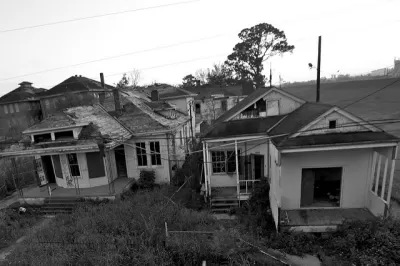
A new development subsidy program by the New Orleans Redevelopment Authority (NORA) is designed to provide new homeownership opportunities in the neighborhood that suffered the most catastrophic damage of any part of New Orleans from Hurricane Katrina, the Lower 9th Ward.
The program "offers subsidies to developers willing to turn some of the vacant Lower 9th Ward properties NORA owns into affordable single-family homes for purchase," reports Jessica Williams.
According to Williams, the new program offers relief to residents and stakeholders in the Lower 9th Ward who believe programs in the neighborhood since Katrina haven't helped the neighborhood recover to its previous conditions. Some neighborhood advocates believe NORA programs have failed to support and attract homeowners since Katrina.
"But developers and some city officials say the demand for homes in the Lower 9th Ward has been lackluster because the neighborhood lacks important services. They see it as a chicken-and-egg problem that might be remedied if public subsidies could be used, at least at first, to lure new renters," explains Williams.
Read the full story: Lower 9th Ward could become home again with subsidies from New Orleans Redevelopment Authority
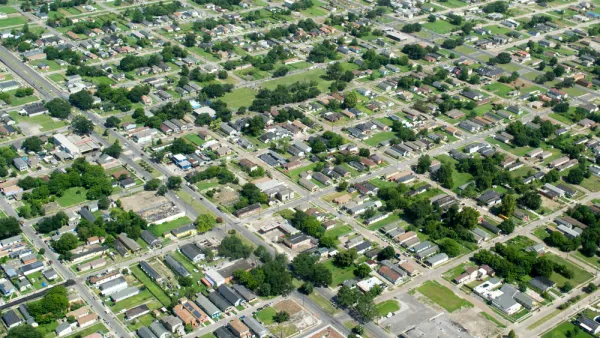
New Orleans Wants to Loosen Zoning Restrictions in the Lower 9th Ward
New Orleans could make it easier to build new homes on small lots in the struggling Lower 9th Ward.

Q&A: New Orleans Planning is 'Visionary within the Envelope of Feasibility'
The following interview, as published in the 4th Edition of the Planetizen Guide to Graduate Urban Planning Programs, features Jason Neville, senior planner for the New Orleans Redevelopment Authority.
Just 17% of San Diego households can afford the city's $1M+ median home prices
The city is becoming increasingly unaffordable to prospective homebuyers.

Planetizen Federal Action Tracker
A weekly monitor of how Trump’s orders and actions are impacting planners and planning in America.

California plans to bury El Niño’s downpour
If the state plays its cards right, it may be able to store a billion acre-feet of El Niño’s water in aquifers.

Desperate measures: Advocates weigh draining Lake Powell to fill Colorado River
Draining the reservoir could reduce evaporation losses by a couple hundred thousand acre-feet.

Mamdani’s pied-à-terre tax survives legal challenge
A panel of judges found that the plaintiffs failed to demonstrate injury as a result of New York City's implementation of the tax.

Eastern Nebraska is running out of electricity
Data centers and electrification are straining eastern Nebraska’s grid, throttling economic development.

Seattle passes record-breaking transit services expansion
Proposition 1 will double the city’s transit tax to add 95,000 more bus trips and preserve 180,000 bus trips annually.

FREE Course: Walkable City 1: Why Walkability?
After describing his path towards focusing on walkability as the essence of good planning, Jeff Speck marches through his five principal reasons for making more walkable places.
Reinventing Malls: Planning Alchemy—Turning Gray Fields Into Gold
The course focuses on the opportunities and imperatives that shape reinvention of mall sites.

City of Rosemead
Rutgers University, Edward J. Bloustein School of Planning and Public Policy
One Hundred Miles
University of Michigan School for Environment and Sustainability (SEAS)
Hunter College, City University of New York (CUNY)
The Architects Foundation
City of Cambridge
Montrose County
The Pocatello Development Authority