Even if widening highways enough to relieve all congestion were possible, it would only benefit a very small number of commuters, according to new research.


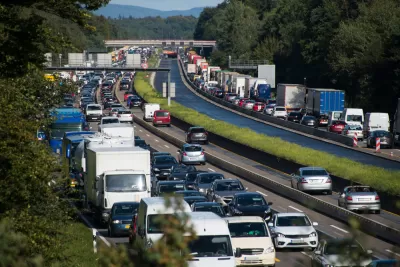
"Urban planners should abandon their obsession with fighting congestion in favor of building more housing in traffic-choked cities because people who live in congested urban centers actually have better access to good jobs and economic opportunity," writes Angie Schmitt.
Schmitt arrives to that conclusion from data provided in a study by researchers from the University of California, Los Angeles, titled "Not so fast? Examining neighborhood-level effects of traffic congestion on job access" and published by the Transportation Research Part A journal.
The study examined the regions around San Francisco and Los Angeles, finding that "commuters who lived near uncongested highways on the fringes of the region couldn’t get to the best jobs faster than people living within the high-traffic areas."
Schmitt provides more detail from the study, while also sending a message to all the state departments of transportation laboring in an effort to built regional automobile transportation systems out of congestion:
Even if congestion could be dramatically improved across the Bay Area, the authors found, the effects on job access would be relatively minor. As frustrating as congestion is to drivers, only 5 to 12 percent of the region’s residents would see an “appreciable” increase in job access if congestion was essentially eliminated, the job access models the team created showed. That, practically speaking, would be impossible or cost prohibitive to accomplish anyway.
FULL STORY: Lack of Housing Is Hurting Urban Workers Far More Than Congestion

Why Don't State DOTs Believe in Induced Demand?
Despite evidence that widening roadways is only a temporary solution to congestion, a decades-long inertia leads states to continue pushing expansion projects against local opposition.
The 'Congestion Con' Debunked
New road capacity doesn't solve congestion, according to the central argument of a new report by Transportation for America.

If Traffic Costs Americans Billions, What About Waiting for Coffee?
The folks over at City Observatory brew up a "Cappuccino Congestion Index" to show that anything can be shown to cost Americans vast sums of money.

Planetizen Federal Action Tracker
A weekly monitor of how Trump’s orders and actions are impacting planners and planning in America.

The state-sanctioned urbicide of Austin
People don’t kill cities. Freeways do.

US to reduce Colorado River water deliveries to Mexico
A new Colorado Treaty amendment reduces Mexico’s Colorado River water allocation by 250,000 acre feet.

5 New England states march closer to 800 megawatt wind energy project
Securing federal approval for the project may be complicated under the Trump administration, which has historically been hostile towards domestic wind power.

Baltimore to break ground on $50 million Transit Priority Project
The project will bring faster bus trips, safer streets and better bike connections to Baltimore.

Airbnb launches $250 million 'last-dollar financing' housing accelerator, makes first investment in Austin
The company will put $6.4 million towards affordable housing development in Texas’ capital.

FREE Course: Walkable City 1: Why Walkability?
After describing his path towards focusing on walkability as the essence of good planning, Jeff Speck marches through his five principal reasons for making more walkable places.
Reinventing Malls: Planning Alchemy—Turning Gray Fields Into Gold
The course focuses on the opportunities and imperatives that shape reinvention of mall sites.

Eagle County Government
Harvard University Graduate School of Design
Nashville Planning Department
The Architects Foundation
University of Cincinnati Online
The Pocatello Development Authority
The Urban Renewal Agency of the City of Pocatello
Journal of the American Planning Association