There's good and bad news from an annual assessment on the Golden State's economy and environment. Gross domestic product per capita increases as emissions per capita decrease, with the major exception of emissions from transportation.


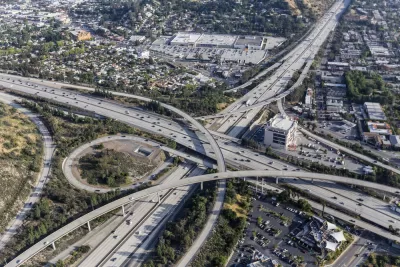
"Climate pollution from transportation hasn’t slowed since 2012 and now represents more than 40 percent of the state’s total, according to an annual assessment from Next 10, a San Francisco based non-profit," reports Eric Roston for Bloomberg News.
The figure represents a “worrisome trend” in a state that has achieved its overall 2020 climate change goal -- to push annual emissions below 1990 levels -- four years early.
“It has become clear that the transportation sector is heading in the wrong direction,” according to the report.
Roston writes that the report, called the 2018 California Green Innovation Index identifies the following reasons for the increase in transportation emissions:
- Californians have shown an increasing aversion to use public transit.
- Difficulty finding affordable housing near work means people have to drive more to their jobs.
- Lower gasoline prices are always greeted warmly -- but attract drivers to pick-ups and sport utility vehicles from more fuel-efficient smaller cars.
The good news in the report is the "long-term transformation in economic growth and energy use." Per capita gross domestic product (GDP) has been increasing while per capita emissions, notwithstanding what Roston calls the "anomalous transportation numbers," decrease. He ends his article on a grim note:
The slide in transportation emissions sullies the popular image of California as the clean-tech-savvy home to Tesla Inc. and 8 percent of the world’s on-road electric car fleet -- equal to the rest of the U.S.
Focus appears to be on tailpipe emissions, not vehicle miles traveled
Roston sees the state's failure to reduce transportation emissions as one reason it has to resist the Trump administration's attempt to revoke the Clean Air Act waiver that allows the state and 12 others to adopt stricter standards than apply for the rest of the nation due to its poor air quality.
The upswing in transportation emissions has not gone unnoticed by Sen. Kevin de León (D-Los Angeles), author of a landmark bill sitting on the governor's desk that requires the state's utilities to generate 100 percent carbon-free electricity by 2045.
"De León, who is challenging Sen. Dianne Feinstein for her seat in Washington, said the next Legislature will have to address tailpipe emissions," reports David R. Baker for the San Francisco Chronicle.
Related post:
July 20, 2018New York Times climate reporter, Brad Plumer, comments on California's landmark accomplishment in reducing emissions, observing that with the low-hanging electricity generation fruit picked, reducing transportation emissions will prove formidable.
Hat tip InsideClimate News.
FULL STORY: California Car Emissions Rise as Trump's Cuts to Standards Loom

California Reaches Greenhouse Gas Emissions Target Four Years Ahead of Schedule
It is possible to achieve state-mandated global warming reduction goals after all. The nation's first such goal, signed into law by Republican governor Arnold Schwarzenegger in 2006, called for reducing emissions to 1990 levels by 2020.
Historic Vote by California Senate on Cap-and-Trade Expected Monday
Caling the upcoming vote on AB 398, which has created strange political bedfellows, "the most important vote of your life," Gov. Jerry Brown cast the decision as choosing between "massive new regulations" and market-based mechanisms.
NRDC Releases State Transportation Scorecard
The Getting Transportation Right report highlights which states are making the most progress on reducing transportation emissions and improving access to clean transportation options.

Planetizen Federal Action Tracker
A weekly monitor of how Trump’s orders and actions are impacting planners and planning in America.

The state-sanctioned urbicide of Austin
People don’t kill cities. Freeways do.

US to reduce Colorado River water deliveries to Mexico
A new Colorado Treaty amendment reduces Mexico’s Colorado River water allocation by 250,000 acre feet.

5 New England states march closer to 800 megawatt wind energy project
Securing federal approval for the project may be complicated under the Trump administration, which has historically been hostile towards domestic wind power.

Baltimore to break ground on $50 million Transit Priority Project
The project will bring faster bus trips, safer streets and better bike connections to Baltimore.

Airbnb launches $250 million 'last-dollar financing' housing accelerator, makes first investment in Austin
The company will put $6.4 million towards affordable housing development in Texas’ capital.

FREE Course: Walkable City 1: Why Walkability?
After describing his path towards focusing on walkability as the essence of good planning, Jeff Speck marches through his five principal reasons for making more walkable places.
Reinventing Malls: Planning Alchemy—Turning Gray Fields Into Gold
The course focuses on the opportunities and imperatives that shape reinvention of mall sites.

Eagle County Government
Harvard University Graduate School of Design
Nashville Planning Department
The Architects Foundation
University of Cincinnati Online
The Pocatello Development Authority
The Urban Renewal Agency of the City of Pocatello
Journal of the American Planning Association