The roads in your city might conform to a grid, or they might divert around natural resources or landmarks. A new tool aims to help you visualize the "hidden logic" behind urban growth.


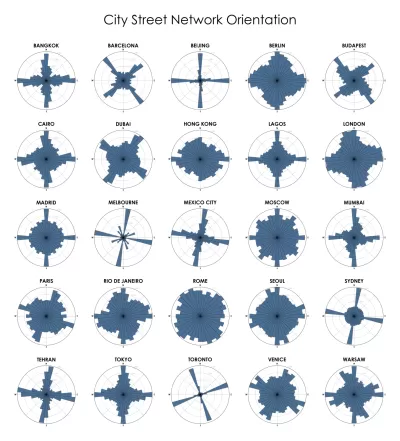
"It works by using an old geography technique: the 'polar' or circular chart. Boeing's tool calculates what percentage of a city's roads run along each section of a compass, and plots it on a circular bar chart."
Because the majority of streets in Manhattan, for example, align along a grid, its network is primarily encompassed in four long bars radiating out from the center of the circle. A few shorter bars represent the smaller portion of streets that don't line up.
Montgomery notes that a similar concept was created recently by data scientist Seth Kadish, but Boeing's adaptation made the model usable by anyone with knowledge of the programming language Python. Developer Vladimir Agafonkin built on Boeing's work to build a version for web browsers, so that "anyone can use a typical web mapping interface to visit any city or other region in the world and see a polar chart of its street grid."
"'It's a wonderful way to explore how cities are built; understand their hidden patterns and influences,' said Agafonkin. 'You can see where a road network was meticulously planned and where it grew naturally. [You can] see subtle connections like terrain, water bodies and nearby attractions influencing the direction of roads.'"
FULL STORY: Visualizing the Hidden ‘Logic’ of Cities

Presenting Municipal Data in an Interactive Map, Nashville Style
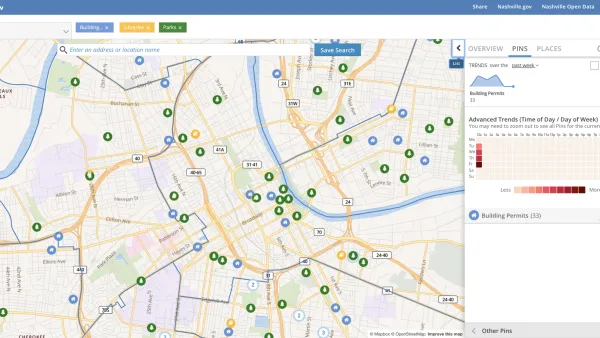
The city of Nashville launched the NashView interactive data map earlier this month.
Metrorail Travel Patterns Revealed
Commute data for one of the nation's premier rail transit systems, revealed.

How the National Park Service Uses GIS
A new book demonstrates how the National Park Service uses GIS technology to meet its mission and showcases a selection of maps used for effectively managing national parks.

The state-sanctioned urbicide of Austin
People don’t kill cities. Freeways do.

US to reduce Colorado River water deliveries to Mexico
A new Colorado Treaty amendment reduces Mexico’s Colorado River water allocation by 250,000 acre feet.

New Jersey’s second-largest city bans standalone data centers
Jersey City will continue to allow co-location facilities, such as those meant for research institutions that store their own data.

Amtrak not solely to blame for New Jersey commuter rail's unreliability, report finds
A new study from the Garden State Initiative found that NJ Transit’s budget grew 20% across a 4 year period, but reliability declined significantly over the same period.

EPA erases limits on planet-warming pollution from power plants
Under Monday’s plan, power plants would still have some limits on how much mercury, arsenic and other contaminants they can emit.

Phoenix announces new on-demand transit service, more frequent RAPID buses
Both new services will launch in October, and are part of Phoenix's Project Effective Access Solutions for Easing Congestion.

FREE Course: Walkable City 1: Why Walkability?
After describing his path towards focusing on walkability as the essence of good planning, Jeff Speck marches through his five principal reasons for making more walkable places.
Reinventing Malls: Planning Alchemy—Turning Gray Fields Into Gold
The course focuses on the opportunities and imperatives that shape reinvention of mall sites.

Eagle County Government
Harvard University Graduate School of Design
Nashville Planning Department
The Architects Foundation
University of Cincinnati Online
The Pocatello Development Authority
The Urban Renewal Agency of the City of Pocatello
Journal of the American Planning Association