“When people feel safe, they ride.”


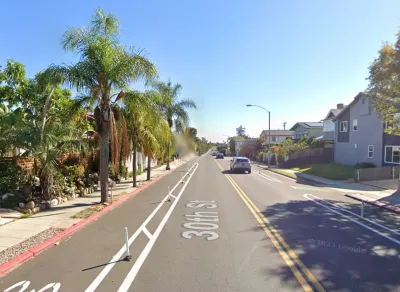
Four years after San Diego installed a protected bike lane on 30th Street, data shows that cycling trips spiked in the year after the lane was installed and have continued growing since.
As Ron Johnson explains in Momentum, annual cycling trips jumped from around 50,000 to 114,682 in the first year after the lane was installed in 2021. “Counts rose another 1.7 per cent in 2023, 5.7 per cent in 2024 and 6.9 per cent in 2025, marking four straight years of growth.”
This data shows that the lanes, which offer access to Balboa Park and connect to other major bikeways, helped change travel behavior in the neighborhood. “What makes 30th Street particularly instructive is how ordinary the opportunity was. The city was already tearing up the road to replace aging pipes. When it resurfaced the street, it chose to build a “complete street” that serves all users.”
Johnson concludes, “For cities looking to meet climate goals or boost local main streets, the lesson is straightforward: when people feel safe, they ride. And when routes connect meaningful destinations, they keep riding.”
Read the full story: Do Protected Bike Lanes Work? San Diego’s 30th Street Offers Four Years of Proof

San Diego budget axes multimodal team at DOT
The budget scales back funding for some bike lane and traffic safety projects that are already in the works.
The 5 Safest Cities for Cyclists in America — and What They Have in Common
Cities with low fatality rates for people on bikes have made strong commitments to building safe, protected bike networks and supporting Complete Streets.
In Defence of Vision Zero — a Traffic Engineer’s Perspective
Traffic engineers have long suffered the reputation that all we care about is moving cars. The reality could not be more different.

Planetizen Federal Action Tracker
A weekly monitor of how Trump’s orders and actions are impacting planners and planning in America.

California plans to bury El Niño’s downpour
If the state plays its cards right, it may be able to store a billion acre-feet of El Niño’s water in aquifers.

Chicago breaks ground on $3 billion megadevelopment
The new neighborhood, titled Foundry Park, will one day host 3,700 residences.

Satanic Place Names
From streams and lakes to valleys and canyons, I mapped more than 1,000 places named after the Devil.

California High-Speed Rail Authority CEO resigns after $600,000 scandal
Under Ian Choudri, the authority used taxpayer dollars to fund first class flights and trips to nightclubs.

Want to study the Missouri River? Soon, you may need unanimous approval from 10 states
Legislation would require 10 governors’ permission to study or build projects moving water outside the basin.

FREE Course: Walkable City 1: Why Walkability?
After describing his path towards focusing on walkability as the essence of good planning, Jeff Speck marches through his five principal reasons for making more walkable places.
Reinventing Malls: Planning Alchemy—Turning Gray Fields Into Gold
The course focuses on the opportunities and imperatives that shape reinvention of mall sites.

City of Rosemead
Rutgers University, Edward J. Bloustein School of Planning and Public Policy
One Hundred Miles
Hunter College, City University of New York (CUNY)
The Architects Foundation
University of Cincinnati Online
City of Cambridge
Montrose County
The Pocatello Development Authority