A new study shows that delivery workers are more likely to stop at red lights and obey traffic rules than recreational or commuter riders.


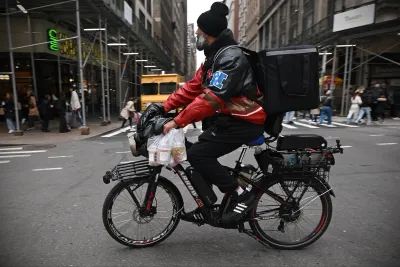
A new study from Hunter College reveals that delivery workers are the safest cyclists in New York City, reports Sophia Lebowitz in Streetsblog USA.
From Streetsblog:
The Hunter College study examined 155 intersections during a three week period in late 2025, when a team of 56 researchers observed individuals using anything that’s not a car to get around: bikes, e-bikes, mopeds and scooters. The researchers looked at the type of vehicles they used and how street design affected their behavior.
The study found that 58 percent of recreational and commuter riders ran a red light during the study period. “By contrast, 55 percent of delivery workers waited entirely for the light to turn green, 27 percent stopped to ensure they were safe and continued, and only 18 percent blew through red lights at speed.”
According to researcher Prof. Mike Owen Benediktsson, “It does stand to reason that deliveristas would be more cautious in their riding. They have more at stake, and they're professionals, they're getting a lot more hours engaged in micromobility riding. And I'm sure that they don't relish the idea of getting into an accident and losing their means of making a living.”
The study found that a lack of bike infrastructure correlates to more cyclists on the sidewalk, “strong evidence” that riders use sidewalks when they feel unsafe in the road. According to Benediktsson, “the feeling of having a formal space in the roadway that belongs to you, is what may explain our finding that people are more law-abiding generally when they're in protected lanes.”
FULL STORY: Delivery Workers Are the Safest Cyclists On the Road, Study Finds


Is that an e-bike or electric motorcycle? A New Washington law clarifies.
New regulations require electric motorcycle riders to have a driver's license.
NYC e-bike injury study highlights 'critical infrastructure deficiencies'
The sharp rise in e-mobility injuries points to a need for safer roads, not more punitive laws.
Carlsbad, California Could Set Age Limits for E-bikes
Some California jurisdictions say a minimum age limit is necessary for high-powered e-bikes due to the high number of injuries in recent years.

The state-sanctioned urbicide of Austin
People don’t kill cities. Freeways do.

US to reduce Colorado River water deliveries to Mexico
A new Colorado Treaty amendment reduces Mexico’s Colorado River water allocation by 250,000 acre feet.

New Jersey’s second-largest city bans standalone data centers
Jersey City will continue to allow co-location facilities, such as those meant for research institutions that store their own data.

Amtrak not solely to blame for New Jersey commuter rail's unreliability, report finds
A new study from the Garden State Initiative found that NJ Transit’s budget grew 20% across a 4 year period, but reliability declined significantly over the same period.

EPA erases limits on planet-warming pollution from power plants
Under Monday’s plan, power plants would still have some limits on how much mercury, arsenic and other contaminants they can emit.

Phoenix announces new on-demand transit service, more frequent RAPID buses
Both new services will launch in October, and are part of Phoenix's Project Effective Access Solutions for Easing Congestion.

FREE Course: Walkable City 1: Why Walkability?
After describing his path towards focusing on walkability as the essence of good planning, Jeff Speck marches through his five principal reasons for making more walkable places.
Reinventing Malls: Planning Alchemy—Turning Gray Fields Into Gold
The course focuses on the opportunities and imperatives that shape reinvention of mall sites.

Eagle County Government
Harvard University Graduate School of Design
Nashville Planning Department
The Architects Foundation
University of Cincinnati Online
The Pocatello Development Authority
The Urban Renewal Agency of the City of Pocatello
Journal of the American Planning Association