Bay Area transportation officials keep expanding car capacity. Lyon’s Croix Rousse Tunnel offers a different way.


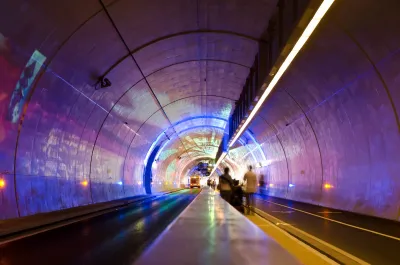
As Alameda, California celebrates a milestone for its water shuttle service and contemplates expanding the service, Roger Rudick points to an underground tunnel in Lyon, France that offers a different solution for shuttling people across water or difficult terrain — without cars.
In Lyon, two sides of the city are connected by two tunnels: one for vehicles built in the 1950s, and another for transit, bikes, and pedestrians built in 2013. The bike/ped side of the tunnel is “a well-lit, art-adorned passageway” that lets people cross safely. Comparing it to the Bay Area, Rudick notes that California transportation engineers have insisted on dedicating both tunnels connecting Oakland and Alameda, the Posey Tube and the Webster Tube, to cars.
For a tiny fraction of what the taxpayer will foot for widening and re-arranging the ramps into the tunnels, they could adapt Lyon's solution and return the Posey Tube to two-way car traffic, as it was originally designed. Then the Webster tube could be repurposed for bikes and buses (or the other way around). That would move far more people for far less money.
Rudick calls on U.S. policymakers to stop saying “we aren’t Europe” and start seeing the potential of projects like Lyon’s Croix Rousse tunnel — even giving people the opportunity to imagine what it could be like. “Let's start with an open-streets event one weekend in one of the tubes to see what people think.”
FULL STORY: Commentary: The French City of Lyon Shows How to Connect Oakland and Western Alameda

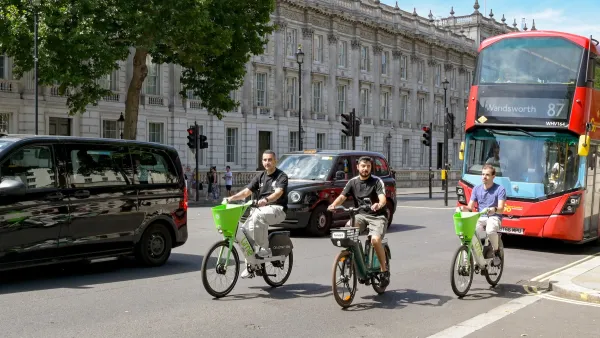
Bike use in London grew by 43% since 2019, but car use remains roughly the same
The city's efforts to reduce car use have stalled despite ambitious programs like congestion pricing and low-traffic neighborhoods.
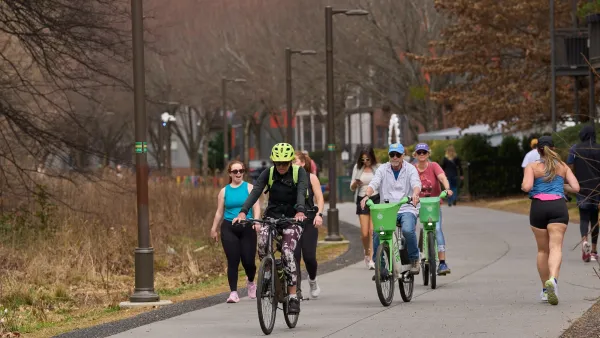
Atlanta could add dedicated bike lane to Beltline
A city councilmember says a dedicated lane would prevent conflicts between cyclists and pedestrians, but others worry it would impede efforts to build transit along the Beltline.
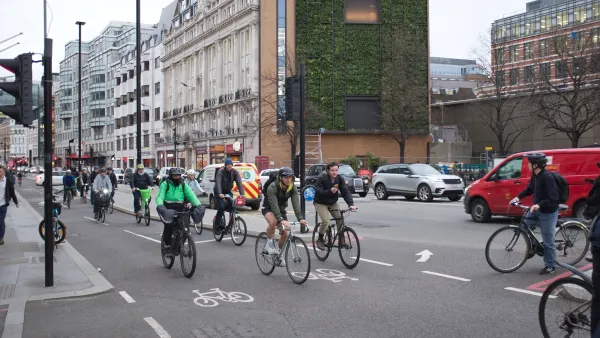
Study: Induced Demand Works for Bikes and Transit, too
If you build it — bike infrastructure, bus lanes, and sidewalks, that is — they will come.

The state-sanctioned urbicide of Austin
People don’t kill cities. Freeways do.

US to reduce Colorado River water deliveries to Mexico
A new Colorado Treaty amendment reduces Mexico’s Colorado River water allocation by 250,000 acre feet.

New Jersey’s second-largest city bans standalone data centers
Jersey City will continue to allow co-location facilities, such as those meant for research institutions that store their own data.

Amtrak not solely to blame for New Jersey commuter rail's unreliability, report finds
A new study from the Garden State Initiative found that NJ Transit’s budget grew 20% across a 4 year period, but reliability declined significantly over the same period.

EPA erases limits on planet-warming pollution from power plants
Under Monday’s plan, power plants would still have some limits on how much mercury, arsenic and other contaminants they can emit.

Phoenix announces new on-demand transit service, more frequent RAPID buses
Both new services will launch in October, and are part of Phoenix's Project Effective Access Solutions for Easing Congestion.

FREE Course: Walkable City 1: Why Walkability?
After describing his path towards focusing on walkability as the essence of good planning, Jeff Speck marches through his five principal reasons for making more walkable places.
Reinventing Malls: Planning Alchemy—Turning Gray Fields Into Gold
The course focuses on the opportunities and imperatives that shape reinvention of mall sites.

Eagle County Government
Harvard University Graduate School of Design
Nashville Planning Department
The Architects Foundation
University of Cincinnati Online
The Pocatello Development Authority
The Urban Renewal Agency of the City of Pocatello
Journal of the American Planning Association