Los Angeles County Parks has launched free emergency care camps at four locations to support wildfire-affected youth and families with meals, activities, and emotional well-being resources while parents focus on recovery.



In response to the devastating Eaton Fire, the Los Angeles County Department of Parks and Recreation has launched emergency care camps to support families affected by the wildfires. Beginning January 13, the program offers children aged 5-12 a safe and nurturing environment to learn and play while their parents focus on recovery efforts. Two locations also provide extended programs for teens aged 13-17. In partnership with organizations like the Dodgers Foundation, Natural History Museum, and LA Philharmonic, the camps offer free field trips, meals, and engaging activities.
Supervisor Kathryn Barger and LA County Parks Director Norma E. García-González emphasized the importance of community resilience and support during this challenging time. The camps, operating through January 31, are available at five locations: Pamela Park, Arcadia Park, Crescenta Valley Community Regional Park, Descanso Gardens, and the Los Angeles County Arboretum. With a 1:5 staff-to-child ratio and a focus on emotional and physical well-being, the camps provide personalized care, meals, and enriching activities for all participants.
In addition to youth programming, parent lounges are available at each site, offering flexible options for family involvement. For registration and further details, families can visit the department’s website or contact [email protected].
Read the full story: LA COUNTY PARKS LAUNCHES EMERGENCY CARE CAMPS FOR WILDFIRE-AFFECTED YOUTH
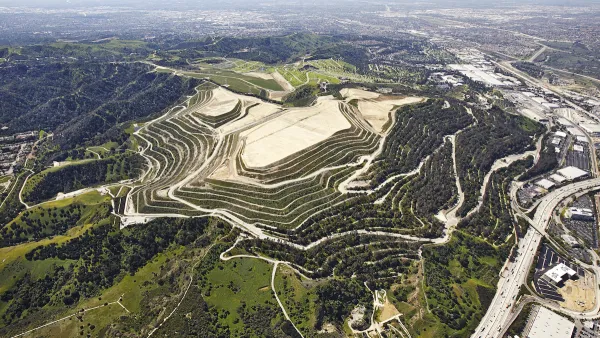
In Los Angeles and beyond, landfills and gas stations are the new public spaces
With scarce urban land, transforming overlooked and underutilized urban pockets into parks and green space it critical to meeting growing community, climate, and equity needs.

Disney Imagineers Join Effort to Rebuild Altadena’s Charles White Park After Wildfire
Disney is contributing $5 million and the talents of its Imagineers to help Los Angeles County rebuild Charles White Park and other fire-damaged Altadena parks.

How South Gate, California Expanded its Park System Against the Odds
With limited space and funding, South Gate opened three new parks this year through community-driven design, creative partnerships, and persistent public leadership.

Planetizen Federal Action Tracker
A weekly monitor of how Trump’s orders and actions are impacting planners and planning in America.

California plans to bury El Niño’s downpour
If the state plays its cards right, it may be able to store a billion acre-feet of El Niño’s water in aquifers.

Desperate measures: Advocates weigh draining Lake Powell to fill Colorado River
Draining the reservoir could reduce evaporation losses by a couple hundred thousand acre-feet.

Mamdani’s pied-à-terre tax survives legal challenge
A panel of judges found that the plaintiffs failed to demonstrate injury as a result of New York City's implementation of the tax.

Eastern Nebraska is running out of electricity
Data centers and electrification are straining eastern Nebraska’s grid, throttling economic development.

Seattle passes record-breaking transit services expansion
Proposition 1 will double the city’s transit tax to add 95,000 more bus trips and preserve 180,000 bus trips annually.

FREE Course: Walkable City 1: Why Walkability?
After describing his path towards focusing on walkability as the essence of good planning, Jeff Speck marches through his five principal reasons for making more walkable places.
Reinventing Malls: Planning Alchemy—Turning Gray Fields Into Gold
The course focuses on the opportunities and imperatives that shape reinvention of mall sites.

City of Rosemead
Rutgers University, Edward J. Bloustein School of Planning and Public Policy
One Hundred Miles
University of Michigan School for Environment and Sustainability (SEAS)
Hunter College, City University of New York (CUNY)
The Architects Foundation
City of Cambridge
Montrose County
The Pocatello Development Authority