Capital Bikeshare saw its fourth straight month of record ridership.


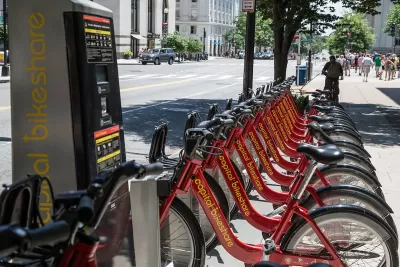
Washington, D.C.’s Capital Bikeshare (CaBi) continues to break ridership records, with August marking the fourth straight month the system saw more rides than ever.
Samuel Littauer describes the system’s success in a piece for Greater Greater Washington, noting, “The regional network has experienced year-over-year monthly ridership increases for 32 consecutive months. Annual ridership continues to thrive as 3,788,634 trips have been taken in 2024—a 31.3% increase from a year prior.”
According to system data, members took 63.2 percent of trips, while 58.6 percent of rides were on e-bikes. The District saw the most rides (86.1 percent) in the region, but Fairfax County plans to expand its bike share service with 16 new stations.
CaBi isn’t the only shared mobility system to see growth: “The region’s largest private micromobility provider, Lime, has also seen significant increases in ridership across their scooters and e-bikes. In a report shared with GGWash, Lime reported 669,000 rides in the District in August, a 41% increase from August 2023.”
FULL STORY: Bikeshare Beat: CaBi breaks all-time ridership record for fourth consecutive month in August


Biking Outpaces Transit Use in DC
D.C. residents and visitors take as many as 30 million trips on bikes or shared mobility, yet bike lanes cover just one quarter of one percent of the District’s streets.

Omaha's 400 shared e-bikes are now free to all residents
Before eliminating fares for locals, the Heartland system only recovered 10%-15% of its operating costs through fare revenue.

DC Bike Share Growing Fast, But Regional Gaps Remain
The wildly popular system ‘frays at its geographic edges,’ making its use less effective outside the central District.

The state-sanctioned urbicide of Austin
People don’t kill cities. Freeways do.

US to reduce Colorado River water deliveries to Mexico
A new Colorado Treaty amendment reduces Mexico’s Colorado River water allocation by 250,000 acre feet.

New Jersey’s second-largest city bans standalone data centers
Jersey City will continue to allow co-location facilities, such as those meant for research institutions that store their own data.

Amtrak not solely to blame for New Jersey commuter rail's unreliability, report finds
A new study from the Garden State Initiative found that NJ Transit’s budget grew 20% across a 4 year period, but reliability declined significantly over the same period.

EPA erases limits on planet-warming pollution from power plants
Under Monday’s plan, power plants would still have some limits on how much mercury, arsenic and other contaminants they can emit.

Phoenix announces new on-demand transit service, more frequent RAPID buses
Both new services will launch in October, and are part of Phoenix's Project Effective Access Solutions for Easing Congestion.

FREE Course: Walkable City 1: Why Walkability?
After describing his path towards focusing on walkability as the essence of good planning, Jeff Speck marches through his five principal reasons for making more walkable places.
Reinventing Malls: Planning Alchemy—Turning Gray Fields Into Gold
The course focuses on the opportunities and imperatives that shape reinvention of mall sites.


Eagle County Government
Harvard University Graduate School of Design
Nashville Planning Department
The Architects Foundation
University of Cincinnati Online
The Pocatello Development Authority
The Urban Renewal Agency of the City of Pocatello
Journal of the American Planning Association