After two warnings, riders who fail to show proof of payment can be issued fines.


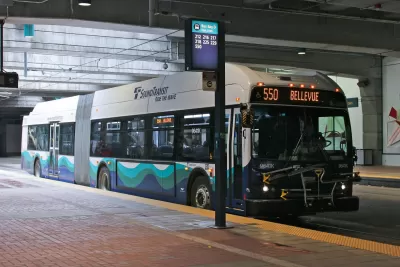
The Seattle area’s Sound Transit will begin enforcing fare compliance on November 15, according to an article in Mass Transit.
“On the third and fourth interactions without proof of payment, passengers will be issued violations that can be resolved with Sound Transit through non-monetary options such as an online class or engagement activity or with a $50 fine for the third violation and a $75 fine for the fourth.” Five or more repeat violations will result in a civil infraction.
The article adds that “Passengers who do not provide valid ID will be asked to exit the train at the next station.”
Sound Transit says the approach “was developed in partnership with communities disproportionately impacted by the effects of fare nonpayment” and that the agency provides several options for reduced fares for low-income riders.
Transit fares, whether they should exist at all, and their enforcement have been a hotly debated topic in transit circles. While advocates for fare-free transit for all say that eliminating fare collection would save agencies money, others argue that free transit would likely come at the expense of effective service.
FULL STORY: Sound Transit to begin issuing fare violations Nov. 15


Sound Transit Adds ‘Fare Ambassadors’ to Enforce Payment
Riders found without proof of payment will have options to pay rather than receive a citation.

Seattle to Reinstate Bus Fare Enforcement
After a COVID-era move to eliminate fare inspections on city buses, King County Metro is reinstating checks for fare evasion.

Seattle Fare Enforcement Disproportionately Punishes Blacks, Data Show
Sound Transit says its fare enforcement system is design to be unbiased, but analysis about fare evader data indicates disparities.

Planetizen Federal Action Tracker
A weekly monitor of how Trump’s orders and actions are impacting planners and planning in America.

The state-sanctioned urbicide of Austin
People don’t kill cities. Freeways do.

US to reduce Colorado River water deliveries to Mexico
A new Colorado Treaty amendment reduces Mexico’s Colorado River water allocation by 250,000 acre feet.

5 New England states march closer to 800 megawatt wind energy project
Securing federal approval for the project may be complicated under the Trump administration, which has historically been hostile towards domestic wind power.

Baltimore to break ground on $50 million Transit Priority Project
The project will bring faster bus trips, safer streets and better bike connections to Baltimore.

Airbnb launches $250 million 'last-dollar financing' housing accelerator, makes first investment in Austin
The company will put $6.4 million towards affordable housing development in Texas’ capital.

FREE Course: Walkable City 1: Why Walkability?
After describing his path towards focusing on walkability as the essence of good planning, Jeff Speck marches through his five principal reasons for making more walkable places.
Reinventing Malls: Planning Alchemy—Turning Gray Fields Into Gold
The course focuses on the opportunities and imperatives that shape reinvention of mall sites.


Eagle County Government
Harvard University Graduate School of Design
Nashville Planning Department
The Architects Foundation
University of Cincinnati Online
The Pocatello Development Authority
The Urban Renewal Agency of the City of Pocatello
Journal of the American Planning Association