After a COVID-era move to eliminate fare inspections on city buses, King County Metro is reinstating checks for fare evasion.



King County Metro announced it will resume fare enforcement on March 31 after a pause of nearly five years, reports Nicholas Deshais for The Seattle Times. “The change has less to do with safety and revenue, and more to do with riders’ perceptions of fairness, according to Metro.” Inspectors will begin boarding buses to ask for proof of payment on March 31, and fare evaders will face fines after May 31.
The agency estimates that roughly 34 percent of riders don’t pay their fare. Violators will get two written warning, then could face tickets of up to $40. People will also have the option to load the $20 onto an Orca transit card, do two hours of community service, or enroll in a reduced fare program.
Fares were suspended under the Safety, Security and Fare Enforcement initiative in June 2020, then reinstated in December of that year. However, King County Metro pledged not to resume enforcement “until the agency could figure out a way to do it fairly.” The new approach eliminates the potential to funnel people into the criminal justice system (under old regulations, a third fare violation resulted in a misdemeanor charge).
FULL STORY: Metro to resume bus fare inspections: What to expect


Sound Transit Adds ‘Fare Ambassadors’ to Enforce Payment
Riders found without proof of payment will have options to pay rather than receive a citation.
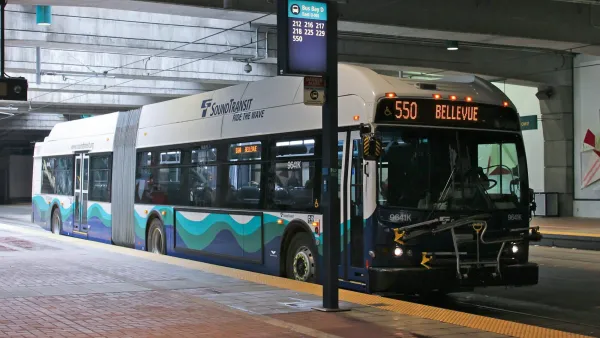
Sound Transit to Start Enforcing Fare Violations This Month
After two warnings, riders who fail to show proof of payment can be issued fines.
Opinion: Fare Evasion Is a Red Herring
The loss of revenue from fare evasion is a drop in the bucket compared to the fiscal cliff facing major U.S. transit agencies.

Planetizen Federal Action Tracker
A weekly monitor of how Trump’s orders and actions are impacting planners and planning in America.

The state-sanctioned urbicide of Austin
People don’t kill cities. Freeways do.

US to reduce Colorado River water deliveries to Mexico
A new Colorado Treaty amendment reduces Mexico’s Colorado River water allocation by 250,000 acre feet.

Mamdani overhauls NYC's Vision Zero plan with 100 new policy goals
The overhaul aims to reduce traffic deaths and make streets safer for pedestrians, cyclists and drivers through lower speed limits, new safety infrastructure and more.

Amtrak not solely to blame for New Jersey commuter rail's unreliability, report finds
A new study from the Garden State Initiative found that NJ Transit’s budget grew 20% across a 4 year period, but reliability declined significantly over the same period.

EPA erases limits on planet-warming pollution from power plants
Under Monday’s plan, power plants would still have some limits on how much mercury, arsenic and other contaminants they can emit.

FREE Course: Walkable City 1: Why Walkability?
After describing his path towards focusing on walkability as the essence of good planning, Jeff Speck marches through his five principal reasons for making more walkable places.
Reinventing Malls: Planning Alchemy—Turning Gray Fields Into Gold
The course focuses on the opportunities and imperatives that shape reinvention of mall sites.

Eagle County Government
Harvard University Graduate School of Design
Nashville Planning Department
The Architects Foundation
University of Cincinnati Online
The Pocatello Development Authority
The Urban Renewal Agency of the City of Pocatello
Journal of the American Planning Association