Four House Democrats joined all but one Republican to enact the Congressional Review Act to roll back President Biden's rule on heavy truck pollution approved by the EPA last December. The Senate had earlier narrowly passed the joint resolution.


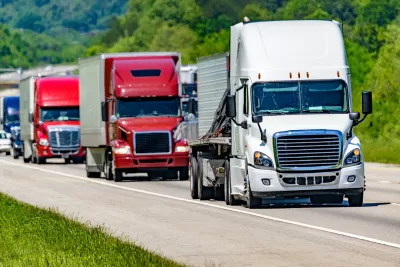
House and Senate Republicans successfully enacted a legislative tool that was heavily used at the beginning of the Trump administration in 2017 to roll back environmental rules approved during the Obama administration. The Congressional Review Act enables both chambers to overturn federally approved rules with a simple majority, thus bypassing the filibuster in the Senate that requires 60 votes. But the resolution is still subject to a presidential veto.
President Joe Biden has signalled that he intends to do just that to save the “Control of Air Pollution from New Motor Vehicles: Heavy-Duty Engine and Vehicle Standards,” approved by the U.S. Environmental Protection Agency on Dec. 20, 2022. It will be his fifth veto since the Republicans took control of the House of Representatives after the red ripple in the midterm elections.
The standards marked “the first update in 20 years to nitrogen oxide rules,” wrote Rachel Frazin who covers energy and environment policy for The Hill, after the rule was approved. NOx are major contributors to ground-level ozone pollution (smog) and particulate matter.
Frazin reported on April 26 on the narrow passage of Senate Joint Resolution 11.
The vote was 50-49. Sen Joe Manchin (D-W.Va.) voted with Republicans to get rid of the rule. Sen. Dianne Feinstein (D-Calif.), who has been absent from the Senate amid health issues, did not vote.
Sen. Deb Fischer (R-Nebraska) made it clear in her statement after the successful vote that her main reason for targeting the air quality rule was inflation and concern that it would not achieve cleaner emissions.
By increasing the cost of a new truck, the regulation actually incentivizes keeping older, higher-emitting trucks in service longer. It would also likely force many “mom & pop” commercial trucking operations out of business while encouraging larger trucking operations to pass these higher costs onto consumers.
House vote
Frazin reports in the source article for this post on the narrow passage (221-203) in the House on May 23. Republicans secured a handful of Democrats from competitive or crossover districts so that the rollback could be viewed as bipartisan.
Democrats Henry Cuellar (Texas), Jared Golden (Maine), Vicente Gonzalez (Texas) and Mary Peltola (Alaska) voted with Republicans in support of overturning the rule. Republican Brian Fitzpatrick (Pa.) voted with the rest of the Democrats against doing so.
Hat tip to The Hill's Energy & Environment newsletter published on May 23.
FULL STORY: House votes in favor of overturning Biden truck pollution rule


Can Federal Emissions Standards Hasten the Transition to EVs?
The EPA unveiled two far-reaching rules to tighten emission standards for light, medium and heavy duty vehicles that can only be met by transitioning to zero-emission vehicles. The proposal is certain to be challenged in court as an agency overreach.

Senate Vote Illustrates America's Polarized Response to Pandemic
A Senate joint resolution to roll back the Biden administration's only vaccine mandate to be upheld by the Supreme Court passed on a party-line vote on March 2. In Europe, the legislative branch often needs to approve these measures to become law.
Bipartisan Support for Federal Diesel Emissions Reduction Bill
Established in 2005 to reduce toxic diesel emissions, the Diesel Emissions Reductions Act expired in 2016. A bipartisan effort appears to be in place to see it reauthorized this year.

The state-sanctioned urbicide of Austin
People don’t kill cities. Freeways do.

US to reduce Colorado River water deliveries to Mexico
A new Colorado Treaty amendment reduces Mexico’s Colorado River water allocation by 250,000 acre feet.

New Jersey’s second-largest city bans standalone data centers
Jersey City will continue to allow co-location facilities, such as those meant for research institutions that store their own data.

Amtrak not solely to blame for New Jersey commuter rail's unreliability, report finds
A new study from the Garden State Initiative found that NJ Transit’s budget grew 20% across a 4 year period, but reliability declined significantly over the same period.

EPA erases limits on planet-warming pollution from power plants
Under Monday’s plan, power plants would still have some limits on how much mercury, arsenic and other contaminants they can emit.

Phoenix announces new on-demand transit service, more frequent RAPID buses
Both new services will launch in October, and are part of Phoenix's Project Effective Access Solutions for Easing Congestion.

FREE Course: Walkable City 1: Why Walkability?
After describing his path towards focusing on walkability as the essence of good planning, Jeff Speck marches through his five principal reasons for making more walkable places.
Reinventing Malls: Planning Alchemy—Turning Gray Fields Into Gold
The course focuses on the opportunities and imperatives that shape reinvention of mall sites.

Eagle County Government
Harvard University Graduate School of Design
Nashville Planning Department
The Architects Foundation
University of Cincinnati Online
The Pocatello Development Authority
The Urban Renewal Agency of the City of Pocatello
Journal of the American Planning Association